 |
| The Silence of the Lambs (Directed by Jonathan Demme) |
Jonathan Demme came to mainstream prominence as a director with his adaptation of The Silence of the Lambs in 1990. Based on Thomas Harris’s novel about a female FBI agent’s hunt for a serial killer under the guidance of the psychopathic Hannibal Lector, the film was a huge success thanks in part to the memorable performance of Anthony Hopkins and garnered five Oscars, including one for Demme. The darkness and bleak humour of the film however is in stark contrast to the brightness and spirited tone of his other work.
Demme was born in 1944 in Baldwin, New York. Exposed by his parents in his early years to foreign films, Demme dropped out of school and worked as a film reviewer which brought him to the attention of the producer Joseph H. Levine. Demme worked tor Levine as a film publicist, and had a sideline as an occasional music writer until a fortunate encounter with producer/director Roger Corman, led him to writing and producing two biker movies with Joe Viola. Demme’s first attempt at directing, the female prison drama Caged Heat (1974), exhibited aspects that would become central to his work; humour, a solidarity with the underdog, a strongly feminist slant, and a love of pop music.
Demme moved into independent films with Handle with Care (1977), renamed Citizens Band, an offbeat comedy that was critically lauded but a box office failure.
Next was a tribute to Alfred Hitchcock, Last Embrace (1979), and Melvin and Howard (1980) a fact based drama about Melvin Dummar’s claim to be a beneficiary to Howard Hughes’ estate. As before, critical praise was not matched by commercial success.
Demme’s next film, Swing Shift (1984), a fictionalised account of the women factory workers of World War II, was marred by production problems. Something Wild (1987), a ‘yuppie nightmare’ movie, Married to the Mob (1988) and The Silence of the Lambs, were more successful and were marked by Demme’s use of strong female leads.
The latter’s huge success now gave Demme considerable influence as a director, and his response was Philadelphia (1993) the first mainstream Hollywood movie to address the AIDS pandemic. Beloved (1998), based on Toni Morrison’s book, tackled slavery, and The Manchurian Candidate (2004) was a new version of the classic 1960s conspiracy thriller.
Throughout Demme’s career, his film ventures were bisected by work in other genres and fields, most notably documentaries that addressed his political interests – on the struggles in Haiti, Hurricane Katrina, and the legacy of former President Jimmy Carter.
Demme was also a highly influential director of rock concerts most notably with Stop Making Sense featuring Talking Heads; Storefront Hitchcock with Robyn Hitchcock; and Neil Young: Heart of Gold. Latterly he was more involved with television work, directing episodes of The Killing and Shots Fired, his final credits as a director.
An intense, gritty, crime odyssey in which an FBI cadet tracks down a serial killer with the help of another incarcerated and manipulative serial killer, The Silence of the Lambs was director Jonathan Demme’s masterwork in suspense, full of unsettling close-ups and disconcerting dialogue. Due to its mix of impressive performances and a sense of claustrophobic dread, it became a modern classic.
In the following extract from an interview with Film Comment magazine, Jonathan Demme discusses his approach to Ted Tally’s screenplay adaptation.
FILM COMMENT: Aside from the fact that it’s a good story with good characters, what was it in ‘The Silence of the Lambs’ that really resonated in you?
JONATHAN DEMME: Ever since my days of working with Roger Corman, and perhaps before that, I’ve been a sucker for a woman’s picture. A film with a woman protagonist at the forefront. A woman in jeopardy. A woman on a mission. These are themes that have tremendous appeal to me as a moviegoer and also as a director.
You weren’t drawn to the serial-killer aspect?
No, I was repelled by the idea of doing a film about a serial killer. Quite apart from do you want to make a film of it, do you want to see a film of it? [Then] I started reading the book, when Orion sent it to me, and I leapt at the chance to get involved with characters of such dimension, and a story with so many complicated and interesting themes.
Why is it that you are drawn to women’s stories?
It has to do with the fact that just in everyday life, in this male-dominated society, women are operating under some handicaps. For women to achieve what they want is harder than for men to achieve what they want. That brings a touch of the underdog to them, and I respond to that. So I’m partial to women in that sense. I think they’re better people, by and large.

Also, the male characters in ‘Melvin and Howard’, ‘Something Wild’, and ‘Married to the Mob’ are not men’s men in their masculinity — there’s a sensitivity to them, a more feminine side in some way.
Well now, Gavin, I don’t want to come across as some kind of sissy in this interview! But I’m pleased you feel that way. Because from what I understand on the subject, we’ve got our female hormones and our male hormones regardless of which sex we happen to be. If I have a female side to me, I value it for the reasons I said before. And I like it when men feel free to not show that they’re the toughest guy around. I find a lot of fault with aggressively tough guys. On every level, globally, personally, this is the sort of attitude that gets us into trouble. I don’t think I’ve particularly done anything with the characters as written, to sort of take them away from a 100-percent maleness. But I may be more drawn to men who are willing to show their vulnerability.
Did you see ‘Silence’ as having a kind of subversive potential?
No. I need to find good scripts that I have regard for in order to do what I do. And apart from constantly searching for a script that would work in the race-relations arena, I don’t really seek out particular kinds of scripts. Something Wild I thought was a wonderful screenplay. I liked its originality. I liked very much that E. Max Frye was able to start us out thinking that we’re seeing one kind of story, and then gradually take us into a much darker kind of story. If there were certain themes about the dark side of America lurking beneath the surface, terrific. But it’s not like a deep-seated vision that exists already within me, and now ‘Something Wild’ comes along and gives me an opportunity to express that. I just respond to writers’ work.
My whole process is really, come to think of it, a series of responses. First, I respond to a writer’s work, and then the next big thing is responding to the work of the actors. And finally, in the cutting room, I’m responding to the footage we’ve wound up with.
I did like that The Silence of the Lambs was a woman’s picture. Is that vaguely subversive? – I don’t know. I haven’t talked to Tom Harris about this, and ultimately I don’t think this is of special interest to moviegoers, but I love that he’s taking some really good pokes at patriarchy while spinning this tale. And I think the movie sort of manages to do that, too.
Some people say directing doesn’t require the creativity or imagination of acting or writing. You talk about responding to things instead of, say, ‘the director’s vision.’
The director doesn’t have to take the creative responsibility of dreaming up what all the actors and crew should be doing. When you start out you think you have to. If you’re working on tight budgets and fast schedules, you think you have to know everything, because if you don’t then how’s it all going to get done in time? But the better the people you work with, the more you realize you can relax and perceive and enjoy and respond.
How did you arrive at your portrayal of Dr. Lecter? There’s almost an abstract quality to him, and you place him in very stylized, gothic settings – not quite real.
More than anything, I was trying to be utterly loyal to the spirit of Lecter as I understood it from the books [Red Dragon – filmed as Manhunter in 1986 – and The Silence of the Lambs] and the script. You read them and you just get a certain kind of feeling about Lecter which stands apart, I think, from all other characters in all other works of fiction. And now he’s got to be on screen. And luckily, it’s going to be Anthony Hopkins bringing him to life. Anthony really knew exactly what to do there. He got this joke.
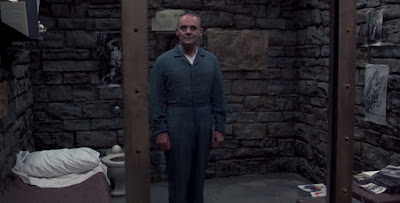
Kristi Zea – the production designer – and I spent a tremendous amount of time trying to deal with the bars on Lecter’s cage. We were never happy with the different looks we were experimenting with. And finally we went to glass. The looks of Lecter’s environments are sort of one step beyond, one step into active imagination in the presence of a lot of ultrarealism elsewhere in the picture.
Were we on some level trying to make it easier for the audience to deal with Lecter? One of the big challenges for this movie was, how do you depict some of the shocking scenes described in the screenplay? Like when the police officers burst into the room in Memphis to discover their fallen partners. Ted wrote, ‘What greets them is a snapshot of hell.’ [Laughs.] Thanks, Ted. But it’s okay, we got that.
It was very hard, because you want to own up to the content of the book and script. But you don’t want to cross the line with people, make people physically ill. You don’t want to compromise them to that extent. You want to give them the good old-fashioned kind of shock they paid their money for without mortifying them. I’m not against mortification in films, by the way, as a moviegoer; but in my own films I think I will always stop well short of it.

But, again, the look of Lecter’s cell block was gothic, even medieval – anything but modern and institutional.
I didn’t want people to feel, for a second, they were seeing anything remotely like a prison movie. When Clarice and Lecter square off against each other, one on the inside of the cage, one on the outside, I didn’t want to settle into a someone-visiting-a-prisoner scene. We aspired to creating a setting for these encounters that would not evoke any other films, that would have a freshness and a scariness all their own.
To me, those encounters are staged somewhere between psychoanalysis sessions — given that Lecter is a psychiatrist – and Catholic confessionals.
I thought it was essential that the movie really put the viewer in Clarice’s shoes. That meant shooting a lot of subjective camera in every sequence she was in; you always had to see what Clarice was seeing. So as the scenes between her and Lecter intensify, inevitably we work our way into the subjective positions. And maybe that brings that heightened sense of intimacy we associate with confessionals or with the psychiatrist’s couch.
You had the actors looking as close to the lens – without looking into the lens – as possible. Standard over-the-shoulder shots or matching singles are done with plenty of distance between the eyeline and the lens – but you cut them as close as possible during those scenes.
Well, in most of them, one is looking slightly off – just slightly – and the other one is smack into the lens. We really pushed for that.

Then in the final sequence in Gumb’s basement she can’t see and the subjective shooting shifts to the killer’s POV through his infrared nightvision goggles.
Exactly. I relished that on a technique-of-making-a-movie level: the idea that we’ll be predominantly in the shoes of the protagonist throughout, and then when she’s deprived of her sight, we’ll be in the shoes of the killer. And perhaps that abandonment of Clarice’s point of view will make the situation even more distressing on a certain dialectic level.
In that scene I felt he was way too close to her. In the book I visualized him stalking her across the basement, instead of on top of her. You made it more claustrophobic.
The idea that Gumb would try to get as close as he possibly could, and touch her hair and – given that he holds the power, he has the gun – he would play with this proximity: that appealed to me as a way to stage the scene.
Overall, how did you approach the material stylistically? What were you aiming for in terms of the look of the film?
It started off with wanting to have a film that was rich in closeups and subjective camera. One of the reasons I work so consistently with Tak Fujimoto is that Tak comes up with a brand new look for every movie. Which is what gifted DPs are supposed to do. I’ve almost stopped talking to him about lighting going into films, because his conception of a look for a film is inevitably going to be a lot more interesting and appropriate than what I might have dreamed up. Because that’s not really one of my strong points – conceiving the kind of lights and shades of a look for a movie.
My only thing was, I didn’t want the film to look like another modish, stylish, moody broody long-shadow catch-the-killer movie. And because of the incredible heaviness of the subject matter, it was important to aspire to a certain brightness whenever possible. To that end, Tak and I looked at Rosemary’s Baby together a couple of times. A very bright picture most of the time. Tak then spun off from there.

But as a director, how do you make sure you’re all making the same movie? Do you sit down with your key people and give them a concrete image to work from?
Noooo...no...no...[Laughs.] I wish I had, but no. We sit down, Tak, Kristi and Chris Newman – our soundman – and we swap views and impressions. The thing is, we were all responding to the book and the screenplay. You read that book and you’re going to come away with an impression of what that stuff looks like. None of us were thrilled about having to depict some of the more shocking aspects of the story. It took months during the pre-production process to get over being appalled at the subject matter. By the time it came to film it, I was happily desensitized, to the degree that I could go out and just do it with great gusto and abandon.
Did the demands of making a real down-the-line, narrative-driven film result in a suppression of your tendency to direct the viewer’s attention towards what’s going on at the edges of the story – the incidental details you have a fondness for?
No, all that energy gets channeled into what the new demands are. I was thrilled to have such a strong story, told at such a relentless pace, to focus all that energy on. What was at the forefront was too important to be distracted by the details on the fringes.
It’s the same thing with any kind of comedic aspect, because most of the pictures I do try to have a very active sense of humor about them, whether or not they’re comedy. And I was just delighted to be freed from the discipline of comedy – not to have to think in terms of where are the laughs going to be, and is this funny enough?
– Gavin Smith, ‘Identity Check: Jonathan Demme Interviewed by Gavin Smith,’ Film Comment 27, no. 1 (1991).
In the following extract from an interview with Film Comment magazine, Jonathan Demme discusses his approach to Ted Tally’s screenplay adaptation.
FILM COMMENT: Aside from the fact that it’s a good story with good characters, what was it in ‘The Silence of the Lambs’ that really resonated in you?
JONATHAN DEMME: Ever since my days of working with Roger Corman, and perhaps before that, I’ve been a sucker for a woman’s picture. A film with a woman protagonist at the forefront. A woman in jeopardy. A woman on a mission. These are themes that have tremendous appeal to me as a moviegoer and also as a director.
You weren’t drawn to the serial-killer aspect?
No, I was repelled by the idea of doing a film about a serial killer. Quite apart from do you want to make a film of it, do you want to see a film of it? [Then] I started reading the book, when Orion sent it to me, and I leapt at the chance to get involved with characters of such dimension, and a story with so many complicated and interesting themes.
Why is it that you are drawn to women’s stories?
It has to do with the fact that just in everyday life, in this male-dominated society, women are operating under some handicaps. For women to achieve what they want is harder than for men to achieve what they want. That brings a touch of the underdog to them, and I respond to that. So I’m partial to women in that sense. I think they’re better people, by and large.

Also, the male characters in ‘Melvin and Howard’, ‘Something Wild’, and ‘Married to the Mob’ are not men’s men in their masculinity — there’s a sensitivity to them, a more feminine side in some way.
Well now, Gavin, I don’t want to come across as some kind of sissy in this interview! But I’m pleased you feel that way. Because from what I understand on the subject, we’ve got our female hormones and our male hormones regardless of which sex we happen to be. If I have a female side to me, I value it for the reasons I said before. And I like it when men feel free to not show that they’re the toughest guy around. I find a lot of fault with aggressively tough guys. On every level, globally, personally, this is the sort of attitude that gets us into trouble. I don’t think I’ve particularly done anything with the characters as written, to sort of take them away from a 100-percent maleness. But I may be more drawn to men who are willing to show their vulnerability.
Did you see ‘Silence’ as having a kind of subversive potential?
No. I need to find good scripts that I have regard for in order to do what I do. And apart from constantly searching for a script that would work in the race-relations arena, I don’t really seek out particular kinds of scripts. Something Wild I thought was a wonderful screenplay. I liked its originality. I liked very much that E. Max Frye was able to start us out thinking that we’re seeing one kind of story, and then gradually take us into a much darker kind of story. If there were certain themes about the dark side of America lurking beneath the surface, terrific. But it’s not like a deep-seated vision that exists already within me, and now ‘Something Wild’ comes along and gives me an opportunity to express that. I just respond to writers’ work.
My whole process is really, come to think of it, a series of responses. First, I respond to a writer’s work, and then the next big thing is responding to the work of the actors. And finally, in the cutting room, I’m responding to the footage we’ve wound up with.
I did like that The Silence of the Lambs was a woman’s picture. Is that vaguely subversive? – I don’t know. I haven’t talked to Tom Harris about this, and ultimately I don’t think this is of special interest to moviegoers, but I love that he’s taking some really good pokes at patriarchy while spinning this tale. And I think the movie sort of manages to do that, too.

Some people say directing doesn’t require the creativity or imagination of acting or writing. You talk about responding to things instead of, say, ‘the director’s vision.’
The director doesn’t have to take the creative responsibility of dreaming up what all the actors and crew should be doing. When you start out you think you have to. If you’re working on tight budgets and fast schedules, you think you have to know everything, because if you don’t then how’s it all going to get done in time? But the better the people you work with, the more you realize you can relax and perceive and enjoy and respond.
How did you arrive at your portrayal of Dr. Lecter? There’s almost an abstract quality to him, and you place him in very stylized, gothic settings – not quite real.
More than anything, I was trying to be utterly loyal to the spirit of Lecter as I understood it from the books [Red Dragon – filmed as Manhunter in 1986 – and The Silence of the Lambs] and the script. You read them and you just get a certain kind of feeling about Lecter which stands apart, I think, from all other characters in all other works of fiction. And now he’s got to be on screen. And luckily, it’s going to be Anthony Hopkins bringing him to life. Anthony really knew exactly what to do there. He got this joke.
Kristi Zea – the production designer – and I spent a tremendous amount of time trying to deal with the bars on Lecter’s cage. We were never happy with the different looks we were experimenting with. And finally we went to glass. The looks of Lecter’s environments are sort of one step beyond, one step into active imagination in the presence of a lot of ultrarealism elsewhere in the picture.
Were we on some level trying to make it easier for the audience to deal with Lecter? One of the big challenges for this movie was, how do you depict some of the shocking scenes described in the screenplay? Like when the police officers burst into the room in Memphis to discover their fallen partners. Ted wrote, ‘What greets them is a snapshot of hell.’ [Laughs.] Thanks, Ted. But it’s okay, we got that.
It was very hard, because you want to own up to the content of the book and script. But you don’t want to cross the line with people, make people physically ill. You don’t want to compromise them to that extent. You want to give them the good old-fashioned kind of shock they paid their money for without mortifying them. I’m not against mortification in films, by the way, as a moviegoer; but in my own films I think I will always stop well short of it.

But, again, the look of Lecter’s cell block was gothic, even medieval – anything but modern and institutional.
I didn’t want people to feel, for a second, they were seeing anything remotely like a prison movie. When Clarice and Lecter square off against each other, one on the inside of the cage, one on the outside, I didn’t want to settle into a someone-visiting-a-prisoner scene. We aspired to creating a setting for these encounters that would not evoke any other films, that would have a freshness and a scariness all their own.
To me, those encounters are staged somewhere between psychoanalysis sessions — given that Lecter is a psychiatrist – and Catholic confessionals.
I thought it was essential that the movie really put the viewer in Clarice’s shoes. That meant shooting a lot of subjective camera in every sequence she was in; you always had to see what Clarice was seeing. So as the scenes between her and Lecter intensify, inevitably we work our way into the subjective positions. And maybe that brings that heightened sense of intimacy we associate with confessionals or with the psychiatrist’s couch.
You had the actors looking as close to the lens – without looking into the lens – as possible. Standard over-the-shoulder shots or matching singles are done with plenty of distance between the eyeline and the lens – but you cut them as close as possible during those scenes.
Well, in most of them, one is looking slightly off – just slightly – and the other one is smack into the lens. We really pushed for that.

Then in the final sequence in Gumb’s basement she can’t see and the subjective shooting shifts to the killer’s POV through his infrared nightvision goggles.
Exactly. I relished that on a technique-of-making-a-movie level: the idea that we’ll be predominantly in the shoes of the protagonist throughout, and then when she’s deprived of her sight, we’ll be in the shoes of the killer. And perhaps that abandonment of Clarice’s point of view will make the situation even more distressing on a certain dialectic level.
In that scene I felt he was way too close to her. In the book I visualized him stalking her across the basement, instead of on top of her. You made it more claustrophobic.
The idea that Gumb would try to get as close as he possibly could, and touch her hair and – given that he holds the power, he has the gun – he would play with this proximity: that appealed to me as a way to stage the scene.
Overall, how did you approach the material stylistically? What were you aiming for in terms of the look of the film?
It started off with wanting to have a film that was rich in closeups and subjective camera. One of the reasons I work so consistently with Tak Fujimoto is that Tak comes up with a brand new look for every movie. Which is what gifted DPs are supposed to do. I’ve almost stopped talking to him about lighting going into films, because his conception of a look for a film is inevitably going to be a lot more interesting and appropriate than what I might have dreamed up. Because that’s not really one of my strong points – conceiving the kind of lights and shades of a look for a movie.
My only thing was, I didn’t want the film to look like another modish, stylish, moody broody long-shadow catch-the-killer movie. And because of the incredible heaviness of the subject matter, it was important to aspire to a certain brightness whenever possible. To that end, Tak and I looked at Rosemary’s Baby together a couple of times. A very bright picture most of the time. Tak then spun off from there.

Noooo...no...no...[Laughs.] I wish I had, but no. We sit down, Tak, Kristi and Chris Newman – our soundman – and we swap views and impressions. The thing is, we were all responding to the book and the screenplay. You read that book and you’re going to come away with an impression of what that stuff looks like. None of us were thrilled about having to depict some of the more shocking aspects of the story. It took months during the pre-production process to get over being appalled at the subject matter. By the time it came to film it, I was happily desensitized, to the degree that I could go out and just do it with great gusto and abandon.
Did the demands of making a real down-the-line, narrative-driven film result in a suppression of your tendency to direct the viewer’s attention towards what’s going on at the edges of the story – the incidental details you have a fondness for?
No, all that energy gets channeled into what the new demands are. I was thrilled to have such a strong story, told at such a relentless pace, to focus all that energy on. What was at the forefront was too important to be distracted by the details on the fringes.
It’s the same thing with any kind of comedic aspect, because most of the pictures I do try to have a very active sense of humor about them, whether or not they’re comedy. And I was just delighted to be freed from the discipline of comedy – not to have to think in terms of where are the laughs going to be, and is this funny enough?
– Gavin Smith, ‘Identity Check: Jonathan Demme Interviewed by Gavin Smith,’ Film Comment 27, no. 1 (1991).


