Monday, 11 October 2021

Sam Peckinpah: Screening Violence

The Wild Bunch (Directed by Sam Peckinpah)
Sam Peckinpah died of heart failure at the age of 59 on December 28th, 1984, following years of hard living. The following day a brief obituary was published in The New York Times. It claimed that Peckinpah, ‘best known for his westerns and graphic use of violence attained notoriety for such films as The Wild Bunch, a brutal picture that was by several thousand red gallons the most graphically violent Western ever made and one of the most violent movies of all time.’ 

Following the release of The Wild Bunch in 1969, Peckinpah became known as ‘Bloody Sam’. In 1971, Peckinpah released Straw Dogs – a brutal tale of rape and revenge set in Cornwall, thus sealing his claim to notoriety as a director of violent films. 

Sam Peckinpah became a bankable, yet controversial director. Much in demand, he sought to justify his work in a series of interviews to a variety of newspapers and magazines while also writing missives to newspaper editors defending his films and rebutting his critics.

Some feminist writers criticised his films for their representation of women and their allegedly unbridled use of violence. The critical consensus coalesced around the idea of Peckinpah as a violent director and the debate that ensued centred not only around the apparently ‘violent films’ but also affected the response to his more meditative works. 

Prior to The Wild Bunch Peckinpah’s work was not particularly noted for its excessively violent themes or style. In his early career Peckinpah had been involved in the production of a number of television serials as well as three feature films including Ride the High Country (1962) and Major Dundee (1965) which were marked by an intelligent and original take on the Western genre. 

Following The Wild Bunch, Peckinpah made the elegaic The Ballad of Cable Hogue (1970) – ‘the story of two guys, a gal and a stretch of desert’. Following the controversial Straw Dogs, Peckinpah directed Junior Bonner (1972) starring Steve McQueen as an ageing rodeo rider. Made in between his forays into violent cinema both The Ballad of Cable Hogue and Junior Bonner are lyrical depictions of individuals in changing times – a theme found in much of Peckinpah’s work including his late masterpiece Pat Garrett and Billy the Kid (1973).

In the following extract from John Cutts’ 1969 interview, Sam Peckinpah discusses his career up to that point and his hopes for the success of The Wild Bunch:

The Wild Bunch (Directed by Sam Peckinpah)
‘The following took place at Sam Peckinpah’s Malibu beach house. A charming, if somewhat crowded, hideaway on that particular Saturday afternoon. For in addition to Peckinpah and myself, there were at least eight children, nine adults, and a wandering python. It was a warm spring day and I felt even warmer due to a touch of flu. Ever the considerate host, Mr. Peckinpah insisted on mixing several personally guaranteed flu cures – all of them containing large amounts of whisky and gin. At the end of the afternoon Mr. Peckinpah presented me with a signed photo bearing the message ‘I wouldn’t have it any other way’ (a line taken directly from ‘The Wild Bunch’). A sentiment, Sam lad, that fits my viewpoint just as well. My thanks again for everything – good talk, the considerable pleasure of your company, the potency of your flu cures, and most important – for introducing me to that damn snake of yours before the gin and whisky began to take effect.’

Let’s begin with some background details. There’s a rumour that you’re part Indian – is that true?

Well, I had a great aunt Jane who was a full-blooded Paiute. Other than that, I’m a Californian, born and raised here – as were my parents and grandparents. My grandfather, Charles Peckinpah, started a sawmill up in Madera County outside Fresno in 1873. There’s a mountain there, the Peckinpah Mountain, where my father was born. My other grandfather, Denver Church ran cattle out of Crane Valley about ten miles away. Old Denver went broke thirteen times, not that it worried him any; cattleman, superior court judge, district attorney, congressman, he had quite a life. Lincoln Peckinpah, Rice Peckinpah, Mortimer Peckinpah – aren’t those great sounding names? It’s a very colourful family.

The Wild Bunch (Directed by Sam Peckinpah)
With your family roots so firm in the soil, how come you were attracted to the theatrical life?

I have no idea. I always wanted to raise cattle – though by temperament I’m completely unsuited, my ranch now is a disaster area. As a kid I used to read a lot (even when working on my grandfather’s pack station up in the high country), used to see as many movies as I could. Maybe the only thing I knew for certain was that I didn’t want to be a lawyer. I took a directing class at Fresno State after leaving the Marines, and that led to enrolling at USC for a master’s degree in drama. After this I sorta drifted: I became producer/director for the Huntingdon Park Theatre, then I went to Alburquerque (wife and baby in tow) to do summer stock as an actor, then I came back to LA to work in TV as a stagehand. KLAC was the station and I stayed there two and a half years until I was fired as a floorsweep on The Liberace Show because I refused to wear a suit. It was at KLAC that I put together some experimental films making them on my own time and money (I started at twenty-five dollars a week, and graduated to eighty-seven fifty). Not that they were any good. More like homework, you might say.

Didn’t you get a job with Allied Artists about this time?

Right. A friend got me in to see Walter Wanger, who got me a job as fourth assistant casting director. A gopher really; you know, go for this, go for that. Then I got upped to dialogue director – with Don Siegel on Riot in Cell Block Eleven in fact.

Invasion of the Bodysnatchers (Directed by Don Siegel)
Aren’t you supposed to have acted as well during this period? There’s a story that you can be seen in Siegel’s ‘Invasion of the Body Snatchers’.  

I played four different parts in Body Snatchers. Peckinpah, man of a thousand faces. I was also stunt man on the picture. Let me think, I was a meter reader, a pod man, and a member of the posse. In addition, Don also had me on it as a writer for two weeks. My best performance, though, is in Wichita (directed by Jacques Tourneur). There’s this great scene I have with Joel McCrea. He comes into the bank and I’m behind the counter. He looks at me. I look at him, and then I say ‘Forty dollars.’ Great stuff. I’m also in The Annapolis Story as a helicopter pilot if you look close enough.

What came next?

I sorta drifted into television writing. While at Allied I met Charles Marquis Warren, and when he became producer of Gunsmoke he asked me to do a script for him. As I remember, it took me five months of day and night writing to get the first one finished. But once the first one was behind me, I breezed ahead writing, I think, at least a dozen Gunsmokes. From this I turned full-time writer, working on The 20th Century Fox Hour, then I created two series of my own in The Rifleman and The Westerner. The first time I was allowed to direct anything was on the Broken Arrow series. I’d written about four segments, so as a gift they let me direct the final show before it came off the air. It really went to my head. There was one scene I must have photographed from at least eighteen different angles. I was never so frightened in my life. Don’t let anyone kid you, it’s bloody murder learning how to direct.

Wichita (Directed by Jacques Tourneur)
How did you make the switch from TV to movies?

Well, I’d developed such a marvellous relationship with Brian Keith on The Westerner series that he kinda took me along with him on The Deadly Companions. Anyway, the producer of the picture, Charlie Fitzsimmonds – Maureen O’Hara’s brother – took me on as a hired hand director. It wasn’t the best deal in the world for either of us. He wanted someone he could push about. I wanted to make a picture as best I could. I offered my services as scriptwriter, which he promptly refused. Every time I’d volunteer for anything. he’d tell me to go back in the corner.

Brian had sense enough to know we were in trouble with the script, so between us we tried to give the thing some dramatic sense. Consequently, all of his scenes have a certain strength. while those with Miss O’Hara (with whom I was forbidden to talk) come off not at all well. At the end of the picture, Mr. Fitzsimmonds took over the editing, scrapping my original cut. He then got into such a mess that he had to return to my original pattern – although I defy anyone to make sense of the ending. If it hadn’t been for Brian and old Bill Clothier, the cameraman, it would have been unbearable.

Ride the High Country (Directed by Sam Peckinpah)
Was it because of ‘The Deadly Companions’ that you were invited to do ‘Ride The High Country’?

I think it helped. Though I think The Westerner series helped more. By the time I came to the pictures, they had a story by N.B. Stone, and Bill Roberts was working on a screenplay. They also had two agreements from Randolph Scott and Joel McCrea to play the leads (though not to play the parts they eventually played: one lunch-time they switehed roles – Scott going from good guy to bad guy, McCrea from bad guy to good guy).

It was a small picture by MGM standards at least, but there was a great excitement about it. We had a good crew – Lucien Ballard as cameraman, Leroy Coleman as art director (he was marvellous: at one point he stole the sails used on the Bounty to make the tents in the mining camp scene), and Frank Santillo as chief cutter. The shooting schedule was tight – we had twenty-four days. I think I went over by two days owing to being snowed out of two locations.

It’s funny to remember, but during the shooting Sol Siegel, the then-head of MGM production, called me and said ‘Stop shooting like John Ford. Learn to behave.’ Well, not knowing what the hell he meant, I kept shooting the way I had from the start. Later, on putting together a first assembly, he called me up again and said ‘You gambled with that funny style of yours - and you’ve won. I like it. Go ahead and make the final cut.’ All of which cheered me enormously.

Ride the High Country (Directed by Sam Peckinpah)
But then MGM underwent a management change – Sol Siegel being replaced by Joe Vogel. Well, the new management took a look at the picture and they hated it – no if’s or but’s. They loathed it. I think it was the wedding scene in the miner’s camp that did it. All those raddled whores. Anyway, Vogel told me that it was the worst film ever made and that he would not release it – unless he was forced to. I was then kicked off the lot, not being allowed to work on the dubbing or the scoring. Though the version that came out was mostly mine – except for twenty-eight feet cut from the brothel scene.

Then, when MGM had to release the picture owing to some overseas booking commitments, a miracle happened – it began to find its audience. The critics were kind – especially in Europe and pretty soon the film began to get the playdates it deserved all along. It was a delayed victory for all of us.

What had you been doing while waiting for ‘High Country’ to come out? 

What I always do in moments of despair – I head back to TV and write westerns. While waiting for High Country to emerge, I did two hour-long features that Dick Powell produced: Pericles on 34th Street and The Losers. The first was a drama, the second a rowdy comedy with Lee Marvin and Keenan Wynn as a couple of conmen on the run. Keenan and Lee had a ball, and the whole thing was a joy to do. I had a good time.
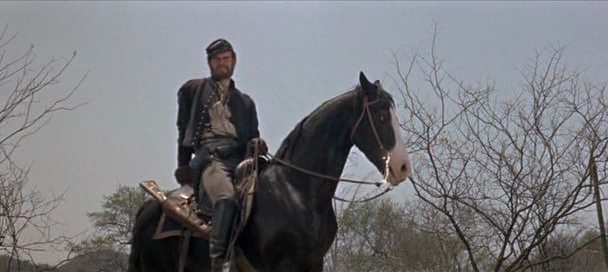
Major Dundee (Directed by Sam Peckinpah)
What came next – ‘Major Dundee’?

Yes. Columbia wanted a picture to be made under three million dollars to fulfil a commitment they had with Chuck Heston. They had a script of sorts – something that Chuck and I both saw potential in providing I could do some re-writing. The producer assigned to the picture, Jerry Bressler, gave his blessing to what we wanted to do – though when it came time to shoot, he double-crossed us by ordering fifteen days cut from the schedule.

Was this when you were actually shooting the picture? 

No, two days prior to starting. I said what he was asking was impossible, that I would rather leave the picture there and then. To which he replied: ‘Look, I’m acting under instructions from New York. Leave it to me, I’ll take care of it.’ But he never did. When I saw the final release print, which is to say Columbia’s final release print, not mine, I was sick to my stomach. I tried to have my name taken off it, but by this time the machinery was too far along. What I had worked so hard to achieve – all of Dundee’s motivation (what it was that made him the man he was) – was gone. This was material I’d both written and shot and cared very much about, but which Bressler or Columbia had thought unnecessary to the total effect of the film.

It’s hard to say who the villain was – maybe Jerry, though he was under tremendous pressure from the studio at that time because he was involved in another picture that wasn’t turning out well... something with Lana Turner, Love Has Many Faces. Major Dundee. It gives me the shivers thinking back on the arguments I had with Bressler and the studio. Maybe I should have argued more strongly going in, telling them in no uncertain terms as to what sort of film I was after rather than taking it for granted that they would let me have my own way once I’d shot the material.

Major Dundee (Directed by Sam Peckinpah)
It’s an odd picture. Marvellous in parts, plain bewildering in others. But from the moment Heston gets involved with Miss Berger it never plays as a whole. That whole Durango episode; Dundee finding degradation in the arms of a whore and that fly-by-night escape, just baffles the hell out of me. 

Well, Berger was wrong, totally wrong. She’s a nice lady, but I should have fought her casting from the start. She was wrong and it hurt the picture. As for Dundee’s degradation, that’s all mine. But where it fails, where it refuses to make sense, lies in the fact that all of Dundee’s motivation, the why behind it all, is all gone. I shot a series of progressive incidents in which Dundee kept failing in what he was doing – punching up the difference between what he set out to achieve and what he achieved. I looked at him very closely, zeroing right in on his locked-in approach to his own ego. All of which was cut and junked. I figure I must have shot about forty-five minutes of Dundee under the microscope. The picture ran beautifully at two hours and forty-one minutes by my cut. Heston was superb. The release print was chopped to two hours and fourteen minutes.

In order to gain some extra shooting time, didn’t Heston offer to return his salary to the studio?

Yes, he made the offer, and they accepted it – they took back their money. It was a very gallant gesture. And you know something, Columbia never had the grace to even have a public preview on the picture. There was a showing for some exhibitors, and that was it, all the final cuts came from that.
Major Dundee (Directed by Sam Peckinpah)
What came next, ‘The Cincinnati Kid’? 

Yes, I prepared the production, spending about four months on it. None of it pleasant, I might add. Marty Ransohoff was the producer, and to put it politely, we did not see eye-to-eye. There was a time when it no longer made sense even to meet with him on story conferences. Steve McQueen too. Steve and I used to meet, talk, then we’d type up a memo for Marty. It was a very strange relationship. I only started to shoot with the agreement that Marty wouldn’t come on the set. Anyway, I started it, shot for four days, then got bounced. Then they hired a new director and made the picture they wanted to make all along.

Rumour hath it that you set out to provoke Ransohoff by shooting take after take of Ann-Margret in the nude.

Untrue. I did a damn good riot scene, then another long scene between Rip Torn and a Negro prostitute in bed, and that was it. Oh, I was also shooting in black and white. They had wanted colour, but I didn’t.

Coming so close on ‘Dundee’, it was obviously a bad time to get fired. 

God protect me from you English – the world’s greatest understaters! But you’re right, I couldn’t get a job anywhere, couldn’t even get into a studio. It was a long, hard period. Then some TV things came along – including the opportunity to write and direct a version of Noon Wine.

Major Dundee (Directed by Sam Peckinpah)
What about the script to ‘The Glory Guys’? 

That had come earlier, about five years previous. Did you ever see it? How about that casting! The same people who made it did another favourite movie of mine – Geronimo, with Chuck Connors in the title role. One of the funniest movies ever made. A positive riot.

What about ‘Villa Rides’? 

Well, the success of Noon Wine sorta took the curse off me. Villa Rides was a straight writing job with little chance of me directing it. I was flown to London to meet Yul Brynner, but he hated the script so much I came home by the next plane. Bob Towne was later hired to do a rewrite on it.

Wasn’t there a time, probably before all this, when there seemed a possibility of you and Disney getting together? 

He called me over to write a Shane-type picture called Little Britches. And I finally came up with the best script I’ve ever written. Walt read it and said ‘too much violence and not enough dogs.’ Well, the violence I plead guilty to, but as for not enough dogs... End of project, though like most things I work on it’ll turn up someday. Did you know I wrote the first script on Brando’s One Eyed Jacks? I worked with Brando for about a month. Very strange man, Marlon. Always doing a number about his screen image, about how audiences would not accept him as a thief, how audiences would only accept him as a fallen sinner – someone they could love. As it was released, I think I’ve only one scene left in the film – the one where Marlon knocks the shit out of Timothy Carey. The rest is all Marlon’s.

The Ballad of Cable Hogue (Directed by Sam Peckinpah)
Let’s come smack up to date. You’ve now made two films back-to-back for Warners-Seven Arts. How did this come about? 

Through the courage and wisdom of one man – Kenny Hyman. When he took over as production chief of Warners-Seven Arts, one of the first people he sent for was me. Kenny had seen Guns and loved it. He’s that sort of person; if he digs you, the studio is yours. Now, Kenny had a project of his own called The Diamond Story he wanted me to do, but when that fell through because of some casting problems, he agreed to let me go ahead on The Wild Bunch.

It’s a western about the betrayal of friendship. An all-guy western with Bill Holden, Bob Ryan, Ernie Borgnine, Eddie O’Brien, Albert Dekker, Ben Johnson, L.Q. Jones and Warren Oates. It’s about a gang of American bandits who steal a US ammunition train and attempt to sell it to some Mexican revolutionaries. It’s about a convict (Robert Ryan) on parole who is ordered to track down all his former friends and gangmates. And it’s very, very violent. During the first preview, thirty-two people walked out during the first ten minutes.

This was during the bank hold-up scene? 

Yeah, the picture begins with a bank hold-up that goes wrong, that ends in slaughter. Wild Bunch is not a pretty picture. It’s the story of violent people in violent times. Violence to the people in the movie is not just a means to an end, it’s the end itself. I make that point very clear. The preview cards were wild: at least thirty per cent said ‘Outstanding. The best picture I’ve ever seen’; and the rest said ‘Disgusting. The most violent picture ever made’; then they’d say ‘Highpoints: the battle scenes, the best ever seen.’ I think a lot of people are going to be shocked – least I hope so. I hate an audience that just sits there.

The Ballad of Cable Hogue (Directed by Sam Peckinpah)
Tell me about the picture that followed ‘The Wild Bunch’. 

It’s a comedy of sorts called The Ballad of Cable Hogue. The story of two guys, a gal and a stretch of desert. Jason Robards and David Warner are the guys, Stella Stevens plays the gal. At the moment we’re still editing, still trying to sort out what we have. I’m trying to figure out a way to use a split-screen technique in it. Not fussy like in Thomas Crown. More like it was done in The Boston Strangler.

A couple of quick, final questions. You’re supposed to be a tough man to work with. 

I work very hard, if that’s what you mean. Or maybe you heard how I fired two dozen people off Cable Hogue? Well, did you see that trade ad the cast and crew took out for me? There’s a difference between the things heard here in Hollywood and the way things happen on location you know.

How fast do you work? Do you overshoot? 

I shoot about 22 to 1, and I cover very well. I have a low take ratio – about two to one. I like to use more than one camera – sometimes as many as three or four.

Any ambition you want to fulfil? 

An awful lot is going to rest on how The Wild Bunch makes out. The studio seem to share my enthusiasm. Whether it’s too violent or not, I simply don’t know. I tried to make it as tough as I know how. As tough, and as honest as I know how. And as far as I’m concerned, the two are quite compatible.

– John Cutts: ‘Shoot! Sam Peckinpah talks to John Cutts’, Films and Filmmaking. 16:1, October 1969, pp. 4-9. Reprinted in ‘Sam Peckinpah: Interviews edited by Kevin J. Hayes, University of Mississippi Press (2008).

Monday, 4 October 2021

Hitchcock’s ‘Psycho’: An American Nightmare

Psycho (Directed by Alfred Hitchcock)
When Alfred Hitchcock was interviewed by Francois Truffaut in the fall of 1962, he had this to say on Psycho: ‘It wasn’t a message that stirred the audiences, nor was it a great performance... they were aroused by pure film.’ Adding that it ‘belongs to filmmakers, to you and me.’

Made in the spirit of a low-budget movie (Psycho cost $800,000), Hitchcock utilised his television crew from Alfred Hitchcock Presents, shot in what was then an unfashionable black and white, deployed long sequences without dialogue and eschewed the traditional narrative path by having the female lead killed early on. Moreover, Hitchcock forced the audience to be attentive while breaking convention, guiding the audience to switch allegiance from Marion Crane’s (Janet Leigh’s) theft and escape, to an audacious sympathy with Anthony Perkins’ mother-fixated serial-killer, Norman Bates. The death of Marion Crane in the infamous shower sequence is followed by Norman’s painstaking clean-up of the crime scene and disposal of her body, car and stolen cash, into a nearby lake. A complex chain that plays with the audience’s identification with Norman’s feelings of fear and guilt.

The film’s melodramatic second half provides two potent set-piece shocks. The private detective Arbogast (Martin Balsam) is killed in a scene that uses back-projection to follow his death-tumble down the stairs. And the secret of Norman’s relationship with his mother is disclosed.

Hitchcock’s relish in how film affects his audience is most apparent in Psycho. ‘I was directing the viewers,’ the director told Truffaut in their book-length interview. ‘You might say I was playing them, like an organ.’


What makes Psycho timeless, however, is that it connects directly with its audience’s primal fears and concerns. Marion Crane takes a detour into a world of randomness, guilt and death. And yet on several occasions Hitchcock remarked that Psycho is a film made with a sense of amusement. ‘It's a fun picture,’ he once quipped. In his book The Art of Alfred Hitchcock: Fifty Years of His Motion Pictures, Donald Spoto writes that the sharp wit of the film is a refusal to submit to the horror and oppression of those fears and impulses which the film so relentlessly explores:

“For most, a first viewing of Psycho is marked by suspense, even mounting terror, and by a sense of decay and death permeating the whole. Yet for all its overt Gothicism – forbidding gingerbread houses, the abundance of mirrors, terrible dark nights of madness and death – repeated viewings leave a sense, above all, of profound sadness. For Psycho describes, as perhaps no other American film, the inordinate expense of wasted lives in a world so comfortably familiar as to appear, initially, unthreatening: the world of office girls and lunchtime liaisons, of half-eaten cheese sandwiches, of motels just off the main road, of shy young men and maternal devotion. But these may just be flimsy veils for spiritual, moral and psychic disarray of terrifying ramifications. 

“Psycho postulates that the American dream has become a nightmare, and that all its components play us false. Hitchcock reveals the emptiness of the dream that a woman can flee to her lover and begin an Edenic new life, forgetting the past. He shows that love stolen at mid-day, like cash stolen in later afternoon, amounts to nothing. He shatters the notion that intense filial devotion can conquer death and cancel the past. Finally, the film treats with satiric, Swiftian vengeance the two great American psychological obsessions: the role of Mother, and the embarrassed secretiveness which surrounds both love-making and the bathroom…. 

“These concerns, these vulnerabilities, raise Marion Crane and Normal Bates almost to the level of prototypes; thus Hitchcock’s insistence on audience manipulation and the resulting identification of viewer with character…. Broader in scope than the bizarre elements of its plot indicate, Psycho has the dimensions of great tragedy, very like Oresteia, Macbeth and Crime and Punishment. In method and content, in the sheer economy of its style and in its oddly appealing wit, it is one of the great works of modern art.”

– Donald Spoto. The Art of Alfred Hitchcock: Fifty Years of His Motion Pictures. New 
York: Hopkins and Blake, 1976.

Tuesday, 28 September 2021

Orson Welles: On Writing ‘Citizen Kane’

Citizen Kane (Directed by Orson Welles)
Overwhelmingly, endlessly, Orson Welles shows fragments of the life of the man, Charles Foster Kane, and invites us to combine them and to reconstruct him. Form of multiplicity and incongruity abound in the film: the first scenes record the treasures amassed by Kane; in one of the last, a poor woman, luxuriant and suffering, plays with an enormous jigsaw puzzle on the floor of a palace that is also a museum. At the end we realize that the fragments are not governed by any secret unity: the detested Charles Foster Kane is a simulacrum, a chaos of appearances... In a story by Chesterton — ‘The Head of Caesar,’ I think — the hero observes that nothing is so frightening as a labyrinth with no center. This film is precisely that labyrinth.  (Jorge Luis Borges)

Citizen Kane unfolds in a series of flashbacks drawn from those closest to the newspaper publisher, and relentlessly follows the reporter seeking in vain to find the meaning of "Rosebud.” The discovery in the last scene that Rosebud was the name of the sled Kane owned in early childhood “is not the answer,” wrote critic Roger Ebert. “It explains what Rosebud is, but not what Rosebud means. The film’s construction shows how our lives, after we are gone, survive only in the memories of others, and those memories butt up against the walls we erect and the roles we play. There is the Kane who made shadow figures with his fingers, and the Kane who hated the traction trust; the Kane who chose his mistress over his marriage and political career, the Kane who entertained millions, the Kane who died alone.” 

Welles, who had lost his parents at a young age, was a child prodigy. “There just seemed to be no limit as to what I could do. Everybody told me from the time I was old enough to hear that I was absolutely marvelous,” he said in a 1982 interview. “I never heard a discouraging word for years. I didn’t know what was ahead of me.” When he was only 23, Time magazine put him on it’s front cover, calling him the “brightest moon that has risen over Broadway in years. Welles should feel at home in the sky, for the sky is the only limit his ambitions recognize.”

Citizen Kane's release on 1 May 1941 was anticipsted with great enthusiasm. Welles had created a major sensation in the New York theatre. He had directed an all-black cast in a staging of Macbeth, which he transposed to Haiti, and set Julius Caesar in the context of Nazi Germany. He had also produced a famous radio broadcast of H.G. Wells War of the Worlds. These triumphs created great anticipation for his debut picture in Hollywood, which had given him unprecedented freedom, which he gleefully seized. 

The picture gained its most passionate audience in France after the Second World War, where future film-makers such as François Truffaut saw it when they were studying experimental film. After years of little attention in the United States, the picture was released in May 1956 and appeared about the same time on TV. In 1962, it came at the top of the poll in Sight & Sound magazine for the greatest film ever made.

The following extracts are taken from an interview with Peter Bogdanovich in which Orson Welles discusses the writing of Citizen Kane:

Peter Bogdanovich: There’s a film written by Preston Sturges called ‘The Power and the Glory’ [1933] which has been said to have influenced you in the flashback style of ‘Kane’. Is that true?

Orson Welles: No. I never saw it. I’ve heard that it has strong similarities; it’s one of those coincidences. I’m a great fan of Sturges and I’m grateful I didn’t see it. He never accused me of it – we were great chums – but I just never saw it. I saw only his comedies. But I would be honored to lift anything from Sturges, because I have very high admiration for him...

PB: The idea for the famous breakfast scene between Kane and his first wife [the nine-year deterioration of their marriage is told through one continuing conversation over five flash-pans] –

OW:  – was stolen from The Long Christmas Dinner of Thornton Wilder! It’s a one-act play, which is a long Christmas dinner that takes you through something like sixty years of a family’s life –

PB: All at dinner –


OW: Yes, they’re all sitting at dinner, and they get old – people wheel baby carriages by, and coffins and everything. That they never leave the table and that life goes on was the idea of this play. I did the breakfast scene thinking I’d invented it. It wasn’t in the script originally. And when I was almost finished with it, I suddenly realized that I’d unconsciously stolen it from Thornton and I called him up and admitted to it.

PB: What was his reaction?


OW: He was pleased...


PB: Just how important was [Herman J.] Mankiewicz in relation to the script?

OW: Mankiewicz’s contribution? It was enormous.


PB: You want to talk about him?


OW: I’d love to. I loved him. People did. He was much admired, you know.


PB: Except for his part in the writing of ‘Kane’... Well, I’ve read the list of his other credits...

OW: Oh, the hell with lists – a lot of bad writers have wonderful credits.


PB: Can you explain that?

OW: Luck. The lucky bad writers got good directors who could write. Some of these, like Hawks and McCarey, wrote very well indeed. Screenwriters didn’t like that at all. Think of those old pros in the film factories. They had to punch in every morning, and sit all day in front of their typewriters in those terrible ‘writers’ buildings.’ The way they saw it, the director was even worse than the producer, because in the end what really mattered in moving pictures, of course, was the man actually making the pictures. The big-studio system often made writers feel like second-class citizens, no matter how good the money was. They laughed it off, of course, and provided a good deal of the best fun – when Hollywood, you understand, was still a funny place. But basically, you know, a lot of them were pretty bitter and miserable. And nobody was more miserable, more bitter, and funnier than Mank,... a perfect monument of self-destruction. But, you know, when the bitterness wasn’t focused straight onto you, he was the best company in the world.


PB: How did the story of ‘Kane’ begin?


OW: I’d been nursing an old notion – the idea of telling the same thing several times – and showing exactly the same scene from wholly different points of view. Basically, the idea Rashomon used later on. Mank liked it, so we started searching for the man it was going to be about. Some big American figure – couldn’t be a politician, because you’d have to pinpoint him. Howard Hughes was the first idea. But we got pretty quickly to the press lords.

PB: The first drafts were in separate versions, so when was the whole construction of the script – the intricate flashback pattern – worked out between you?

OW: The actual writing came only after lots of talk, naturally,...  just the two of us, yelling at each other – not too angrily.

PB: What about the ‘Rashomon’ idea? It’s still there to a degree.

OW: It withered away from what was originally intended. I wanted the man to seem a very different person depending on who was talking about him. ‘Rosebud’ was Mank’s, and the many-sided gimmick was mine. Rosebud remained, because it was the only way we could find to get off, as they used to say in vaudeville. It manages to work, but I’m still not too keen about it, and I don’t think that he was, either. The whole shtick is the sort of thing that can finally date, in some funny way.

PB: Toward the close, you have the reporter say that it doesn’t matter what it means  –

OW: We did everything we could to take the mickey out of it.


PB: The reporter says at the end, ‘Charles Foster Kane was a man who got everything he wanted, and then lost it. Maybe Rosebud was something he couldn’t get or something he lost, but it wouldn’t have explained anything...’


OW: I guess you might call that a disclaimer – a bit corny, too. More than a bit. And it’s mine, I’m afraid.

PB: I read the script that went into production... There were so many things you changed on the set, or, anyway, after you’d started shooting. From the point of view of Kane’s character, one of the most interesting is the scene where you’re remaking the front page for about the twentieth time. In the script, Kane is arrogant and rather nasty to the typesetter. In the movie, he’s very nice, even rather sweet. How did that evolve?

OW: Well, all he had was charm – besides the money. He was one of those amiable, rather likable monsters who are able to command people’s allegiance for a time without giving too much in return. Certainly not love; he was raised by a bank, remember. He uses charm the way such people often do. So when he changes the first page, of course it’s done on the basis of a sort of charm rather than real conviction... Charlie Kane was a man-eater.

PB: Well, why was it in the script the other way?


OW: I found out more about the character as I went along.


PB: And what were the reactions of Mankiewicz to these changes?

OW: Well, he only came once to the set for a visit. Or, just maybe, it was twice...


PB: Before shooting began, how were differences about the script worked out between you?

OW: That’s why I left him on his own finally, because we’d started to waste too much time haggling. So, after mutual agreements on story line and character, Mank went off with Houseman and did his version, while I stayed in Hollywood and wrote mine. At the end, naturally, I was the one who was making the picture, after all – who had to make the decisions. I used what I wanted of Mank’s and, rightly or wrongly, kept what I liked of my own.

PB: As you know, Houseman has repeatedly claimed that the script, including the conception and structure, was essentially Mankiewicz’s.

OW: It’s very funny that he does that, because he deserves some credit himself. It’s very perverse, because actually he was a junior writer on it, and made some very important contributions. But for some curious reason he’s never wanted to take that bow. It gives him more pleasure just to say I didn’t write it...

PB: What was the influence of your guardian, Dr. Bernstein? And why did you give that name to the character in ‘Kane’?

OW: [laughs] That was a family joke. He was nothing like the character in the movie. I used to call people ‘Bernstein’ on the radio all the time, too – just to make him laugh... I sketched out the character in our preliminary sessions – Mank did all the best writing for Bernstein. I’d call that the most valuable thing he gave us...


PB: Yes, that scene with the reporter [William Alland] –

OW: That was all Mank, by the way – it’s my favorite scene.

PB: And the story about the girl: ‘One day, back in 1896, I was crossing over to Jersey on the ferry... There was another ferry pulling in, and... a girl waiting to get off. A white dress she had on... I only saw her for a second... but I’ll bet a month hasn’t gone by since, that I haven’t thought of that girl.’

OW: It goes longer than that.

PB: Yes, but who wrote it?

OW: Mankiewicz, and it’s the best thing in the movie. ‘A month hasn’t gone by that I haven’t thought of that girl.’ That’s Mankiewicz. I wish it was me.

PB: Great scene.

OW: If I were in hell and they gave me a day off and said, ‘What part of any movie you ever made do you want to see?’ I’d see that scene of Mank’s about Bernstein. All the rest could have been better, but that was just right...

PB: You once said about the editing of ‘Kane’, ‘There was nothing to cut.’ What did you mean?

OW: When I made Kane, I didn’t know enough about movies, and I was constantly encouraged by [cinematographer Gregg] Toland, who said, under the influence of Ford, ‘Carry everything in one shot – don’t do anything else.’ In other words, play scenes through without cutting, and don’t shoot any alternate version. That was Toland in my ear. And secondly, I didn’t know how to have all kinds of choices. All I could think of to do was what was going to be on the screen in the final version. Also, I had a wonderful cast...


PB: Why did you decide not to have credits at the beginning of ‘Kane’? No one had ever done that before.

OW: The script dictated that. Look at all the other things that go on at the beginning, before the story starts: that strange dreamlike prologue, then ‘News on the March,’ and then the projection-room scene – it’s a long time before anything starts. Now, supposing you’d added titles to all that. It would have been one thing too much to sit through. You wouldn’t have know where you were in the picture.

PB: In that prologue you just mentioned, why does the light in his bedroom suddenly go off – and then come on again after a moment?

OW: To interest the audience. We’d been going on quite a while there with nothing happening. You see a light in the window – you keep coming nearer – and it better go off, or a shadow had better cross, or something had better happen. So I turned the light off – that’s all.

PB: Then you cut inside.


OW: That’s right. Maybe the nurse turned it off because it was getting in his eyes. Who knows? Who cares? The other answer is that it symbolized death. Got that? All right...

PB: What did you mean by the mirrors at the end, when Kane walks by and you see his image reflected many times?

OW: I don’t think a moviemaker should explain what he means. About anything. Leave it to the customers. Why spoil things for people who enjoy finding their own meanings?

PB: But you just explained the light going off –


OW: Next.


PB: The black smoke at the end has been said to symbolize the futility of his life...


OW: I don’t know – I hate symbolism.


PB: Fritz Lang said he dropped the use of symbols when he came to America because somebody at MGM said to him, ‘Americans don’t like symbols.’


OW: I’m one of those Americans. I never use it. If anybody finds it, it’s for them to find. I never sit down and say how we’re going to have a symbol for some character. They happen automatically, because life is full of symbols. So is art. You can’t avoid them; but if you use them, you get into Stanley Kramer Town.

PB: I know you hate to think up titles –

OW: No! I love to think ’em up, but can’t! Citizen Kane came from George Schaefer – the head of the studio, imagine that! It’s a great title. We’d sat around for months trying to think of a name for it. Mankiewicz couldn’t, I couldn’t, none of the actors – we had a contest on. A secretary came up with one that was so bad I’ll never forget it: A Sea of Upturned Faces.

PB: Can we talk about Leland’s betrayal of Kane?

OW: He didn’t betray Kane. Kane betrayed him.


PB: Really?


OW: Because he was not the man he pretended to be.


PB: Yes, but, in a sense, didn’t Leland –


OW: I don’t think so.


PB: I was going to say something else. Didn’t Leland imagine that Kane was one thing and then was disappointed when he wasn’t?


OW: Well, it comes to the same thing. If there was any betrayal, it was on Kane’s part, because he signed a Declaration of Principles which he never kept.


PB: Then why is there a feeling that Leland is petty and mean to Kane in the scene when he gets drunk?


OW: Because there he is – only there, because he’s defensive. It’s not the big moment. The big moment is when he types the bad notice afterward. That’s when he’s faithful to himself and to Kane and to everything.

PB: I wonder if that’s as simple as your answer is now, because if you were put in a position like
that –

OW: I’m not his character. I’m a totally different kind of person from Jed Leland. I’m not a friend of the hero. And he’s a born friend of the hero, and the hero turned out not to be one. He’s the loyal companion of the great man – and Kane wasn’t great; that’s the story. So of course he’s mean and petty when he’s discovered that his great man is empty inside.

PB: Well, maybe one feels that Leland could have afforded to write a good review.

OW: Not and been a man of principle. That Declaration of Principles Kane signed is the key to it. Leland couldn’t – no critic can. He’s an honest man. Kane is corrupt. I don’t think he betrays Kane in any way.


PB: Well, one has an emotional response to Kane in the picture, and I certainly felt that Leland betrays him – I felt that emotionally.

OW: No, he doesn’t. You’re using the word ‘betrayal’ wrong. He’s cruel to him, but he doesn’t betray him.

PB: Well, he betrays their friendship, then.

OW: He doesn’t. It’s Kane who betrayed the friendship. The friendship was based on basic assumptions that Kane hadn’t lived up to. I strongly and violently disagree with that. There is no betrayal of Kane. The betrayal is by Kane.

PB: Then why do I somewhat dislike Leland?


OW: Because he likes principles more than the man, and he doesn’t have the size as a person to love Kane for his faults.

PB: Well, then, there you are.


OW: But that’s not betrayal. ‘Betrayal’ is a dead wrong word. He simply doesn’t have the humanity, the generosity of spirit, to have been able to endure Kane...

PB: Do you think that Thompson, the reporter, is changed by going through the Kane story? Is he altered?


OW: He’s not a person. He’s a piece of machinery –

PB: To lead you through.


OW: Yes.


PB: Was there any mystery before the Rosebud element? I mean, did you try anything else?


OW: Yes. And there was a scene in a mausoleum that I wrote – it was a quotation from a poem or something, I can’t remember – and Mankiewicz made terrible fun of it. So I believed him and just said, ‘All right, it’s no good.’ It might have been good – I don’t remember it, because I was so ashamed from Mankiewicz’s violent attack on it.

PB: Why did you begin and end with the No Trespassing sign?

OW: What do you think? Anybody’s first guess has got to be right.


PB: A man’s life is private.


OW: Is it? That should theoretically be the answer, but it turns out that maybe it is and maybe it isn’t...


PB: Is the name Kane a play on Cain?


OW: No, but Mankiewicz got furious when I used that name, because he said that’s what people will think. We had a big fight about that.

PB: The original name was Craig.


OW: Yes. And I said I thought Kane was a better name –


PB: Just because it was a better name –


OW: Yes. And Mankiewicz made the other point: ‘They’ll think you’re punning on Cain’ and all that, because we had a big murder scene in the original script. And I said they won’t, and he said they will, and so on. I won...


PB: Did you notice an influence on Hollywood films from ‘Kane’?

OW: You couldn’t mistake it. Everybody started having big foreground objects and ceilings and all those kind of compositions. Very few people had ever even used a wide-angle lens except for crowd scenes.

PB: But the effect wasn’t in terms of story construction?


OW: No, the things that I valued didn’t seem to have much effect on anybody. But the most obvious kind of visual things, everybody did right away.

PB: It seemed to me that your memory of your mother is reflected in the scenes with Kane’s mother.

OW: Not at all. She was so different, you know.

PB: I don’t mean the character, but the affection of Kane –

OW: Really no comparison. My mother was very beautiful, very generous, and very tough. She was rather austere with me.

PB: Well, the mother in ‘Kane’ was not a sentimental mother –

OW: It isn’t that. There’s just not any connection.


PB: It’s not so much the mother herself but the emotion of remembering a mother. As in the scene where you meet Dorothy Comingore and tell her you’re on a trip in search of your youth, and she has that line, ‘You know what mothers are like.’ And you say, in a sad, reflective tone, full of memories, ‘Yes.’ It’s one of my favorite moments in the picture.

OW: No, Peter, I have no Rosebuds.


PB: But do you have a sentiment for that part of your past?

OW: No... I have no wish to be back there... Just one part of it, maybe. One place. My father lived sometimes in China, and partly in a tiny country hotel he’d bought in a village called Grand Detour, Illinois. It had a population of 130. Formerly it was ten thousand, but then the railroad didn’t go through. And there was this hotel which had been built to service the covered wagons on their way west through southern Illinois (which is real Mark Twain country, you know, and people like Booth Tarkington). My father spent a few months of his year there, entertaining a few friends. They never got a bill. And any legitimate hotel guests who tried to check in had a tough time even getting anyone to answer that bell you banged on the desk. Our servants were all retired or ‘resting’ from show business. A gentleman called Rattlesnake-Oil Emery was handyman. One of the waitresses had done bird calls in a tent show. My father was very fond of people like that.

Well, where I do see some kind of Rosebud, perhaps, is in that world of Grand Detour. A childhood there was like a childhood back in the 1870s. No electric light, horse-drawn buggies – a completely anachronistic, old-fashioned, early-Tarkington, rural kind of life, with a country store that had above it a ballroom with an old dance floor with springs in it, so that folks would feel light on their feet. When I was little, nobody had danced up there for many years, but I used to sneak up at night and dance by moonlight with the dust rising from the floor... Grand Detour was one of those lost worlds, one of those Edens that you get thrown out of. It really was kind of invented by my father. He’s the one who kept out the cars and the electric lights. It was one of the ‘Merrie Englands.’ Imagine: he smoked his own sausages. You’d wake up in the morning to the sound of the folks in the bake house, and the smells... I feel as though I’ve had a childhood in the last century from those short summers.

PB: It reminds me of ‘Ambersons’. You do have a fondness for things of the past, though –

OW: Oh yes. For that Eden people lose... It’s a theme that interests me. A nostalgia for the garden – it’s a recurring theme in all our civilization.


– From Peter Bogdanovich: Interview with Orson Welles. In Orson Welles’s Citizen Kane:  A Casebook (ed. James Naremore. OUP, 2004)


Friday, 24 September 2021

The World of John Ford

The Searchers (Directed by John Ford) 
Ford’s major works can be traced in a rising parabola from Steamboat ‘Round the Bend and Judge Priest in the mid-Thirties to the extraordinary American trilogy in 1939 – Stagecoach, Young Mr. Lincoln, and Drums Along the Mohawk – and then on to the postwar classics beginning with My Darling Clementine and culminating with The Man Who Shot Liberty Valance. How Green Was My Valley established Maureen O’Hara as the definitive Ford heroine, just as Stagecoach established John Wayne as the definitive Ford hero. The extraordinary rapport of the Wayne-O’Hara team through Rio Grande, The Quiet Man, and Wings of Eagles adds a sexual dimension to Ford’s invocation of tradition in human experience. How Green Was My Valley is also notable for introducing Ford’s visual treatment of the past as a luminous memory more real than the present, and presumably more heroic than the future. Ford and Hawks, the directors closest to the Griffith tradition, project different aspects of Griffith’s personality: Ford, the historical perspective and unified vi­sion of the world: Hawks: the psychological complexity and innate nobility of characterization. Of course, Ford can never become fashionable for the rigidly ideological critics of the Left. Too many of his characters wear uni­forms without any tortuous reasoning why. Even the orig­inally pacifistic What Price Glory is transformed by Ford into a nostalgic celebration of military camaraderie with the once raucous Charmaine emerging from the dim shad­ows as an idealization of the Chivalric Code. As a director, Ford developed his craft in the Twenties, achieved dramatic force in the Thirties, epic sweep in the Forties; and symbolic evocation in the Fifties. His style has evolved almost miraculously into a double vision of an event in all its vital immediacy and also in its ultimate memory-image on the horizon of history. – Andrew Sarris

The following extract is from an interview with John Ford by Jean Mitry. It appeared originally in Cahiers du Cinema, No. 45, March 1955 and was translated by Andrew Sarris.


The Informer (Directed by John Ford) 
Ford said he made films because it was his trade, which he liked. ‘But for producers,’ he continued, ‘there are other considerations, commercial ones, which must be re­spected. You see directors disappear, or make nothing but mediocre pictures. It is not that they have less talent, or that they have lost their ability. It is that they have turned out one film after another without box-office appeal, with the result that they lose their prestige and wind up on the beach. They must start again from the bottom to regain the confidence of producers. That can take a long time, and sometimes they are restricted to mediocre projects.’

The best directors can be defeated by this process of aesthetic attrition, and after enough setbacks they lose their ambition.

According to Ford’s calculations, directors who want to make only artistic films get a chance to do so about once every ten years. If the film is a commercial success, they get another chance, but otherwise they are through. ‘Only rarely,’ Ford added, ‘does the opportunity arise to make such films two or three times in a row.’

The secret, Ford said with the utmost seriousness, is to turn out films that please the public, but that also reveal the personality of the director. ‘That isn’t easy,’ he added.

I asked if he didn’t always do what he wanted.

‘What I want, yes, but what I would like to do, cer­tainly not.’

Stagecoach (Directed by John Ford) 
‘Do you choose your scripts or are they chosen for you?’

It depends, he explained, on the studio that employs him and on the kind of contract he signs. In rare exceptions Ford has what amounts to a choice – from among a dozen possible projects he may choose the one he likes best. In all his films, he said, he tries to maintain a certain feeling, a unity, and to retain in the script only that which contributes to this unity and sets forth his personality.

‘But that isn’t always possible,’ he exclaimed, ‘and I must make films whose success is assured in advance in order to have the right, and the opportunity, to make oth­ers that are commercial risks but more worthwhile. On their success hangs my freedom of action. In this way I have been able to make some films I wanted to make, and to make them according to my tastes and weaknesses. But I haven’t been able to make ten such films.

‘I waited four years to do The Informer and got the chance only after every sort of hesitation. Then I had a little more luck and was able to choose films which left me a certain leeway in which to express myself.’

‘But are you not also a producer?’

‘Yes, but like all producers, I am subject to the de­mands of the distributors. There’s not much freedom in being a producer. In fact, one takes on more worries – the financial ones. One is doubly responsible – for the film, and for the money. Like other producers, I hesitate to throw myself into an attractive but risky project.

Fort Apache (Directed by John Ford) 
‘At the moment I want to make – in Ireland, for very lit­tle money, a picture for my pleasure, to be called The Three Leaf Clover (later filmed as The Rising of the Moon). I hope it will express some of the poet­ry of my native land. After that I shall undertake a big Western with a subject that interests me – one that corre­sponds to what you call ‘my world.’ It is called – The Search (sic) and is set in the Rocky Mountains and concerns some pioneers who seek a little girl taken away by Indians. It’s a kind of psychological epic.’

I then ventured, the opinion that he seemed in almost all his films to have this theme of a small group of people thrust by chance into dramatic or tragic circumstances.

‘On purpose?’ I asked.

‘It seems so to me,’ he replied. ‘It enables me to make individuals aware of each other by bringing them face to face with something bigger than themselves. The situation, the tragic moment, forces men to reveal themselves, and to become aware of what they truly are. The device allows me to find the exceptional in the commonplace. I also like to discover humor in the midst of tragedy, for tragedy is never wholly tragic. Sometimes tragedy is ridiculous. I should like to do a tragedy, the most serious in the world, that turned into the ridiculous.’


She Wore A Yellow Ribbon (Directed by John Ford) 
‘Your penchant for unity of time and place,’ I asked, ‘does it tempt you to play down the story in order to make a film more universal, more abstract?’

‘Not at all!’ Ford said quickly. ‘That may be the re­sult, but it certainly is not the end. Unity of time and place is solely a means of defining the drama and individu­als, a way of getting there more directly and quickly. I look, before all else, for simplicity, for the naked truth in the midst of rapid, even brutal, action. To be as selective about time and place as one is about the action is to get rid of useless complications. When the circumstances are clearly comprehended, the force of the conflict is in­creased, since its effects are more completely understood. Time is important only when one follows individuals through all their lives.

‘I suppose everybody pursues one idea in many guises. In any event, everybody tends to emphasize those aspects of life he finds the most interesting. Movie directors cer­tainly do. What interests me are the consequences of a tragic moment – how the individual acts before a crucial act, or in an exceptional circumstance. That is everything.

‘However, a situation must never limit a director. It must never be more than a point of departure.’

My Darling Clementine (Directed by John Ford) 
‘How do you work?’ I asked. ‘Do you just shoot a scenario finalized by others, or do you collaborate on the cutting?’

‘The cutting! I do it myself. And I plan the film. When a subject interests me, I also take part in the scripting. If the subject doesn’t interest me, I am satisfied to do my job to everybody’s best interest. When I work with a scriptwri­ter, he outlines the situations, develops the continuity, writes the dialogue. The shooting arrangements, and the cutting, I do myself. We have numerous conferences with the cameraman, the set designer, and sometimes the actors. Each one knows what he has to do and understands the picture before starting to work it. A well-prepared film is shot quickly.’

I then remarked that some of my colleagues were sur­prised that American directors remain seated during the shooting of a scene. Ford was astonished.

‘What do you want them to do?’ he asked. ‘They ob­serve, they control, they direct. Everything is arranged be­forehand. There are assistants who rehearse the actors, who set the scene. It is quickly done. There is nothing more to do than to integrate it into a whole, to make it flexible. If everything goes well there’s no reason to be nervous.’

The Long Voyage Home (Directed by John Ford) 
‘Do you determine what the camera shall see?’

‘With the cameraman. It’s done in advance. A good cam­eraman knows how a shot should be framed. I have al­ways had excellent cameramen. Sometimes, when the com­position is very detailed, I may take over, but usually a few suggestions are enough.’

‘You never improvise?’

‘Oh certainly – but strictly within the predetermined framework. You can change cue, modify an incident, but the movement of the camera, like its position, is deter­mined in advance. A director who changes his mind is a director who loses time. You should make your decisions before, not during the shooting.’

‘But if a movement of the camera proves impossible?’

‘The director doesn’t know his job. You should know in advance what is and isn’t possible. I sometimes make a film in three weeks – after six months of preparation.

‘What would you think of an architect who arrived at his building wondering where to put the staircase? You don’t ‘compose’ a film on the set; you put a predesigned composition on film. It is wrong to liken a director to an author. He is more like an architect, if he is creative. An architect conceives his plans from given premises – the purpose of the building, its size, the terrain. If he is clever, he can do something creative within these limitations. Ar­chitects do not only create monuments and palaces. They also build houses. How many houses are there in Paris for every monument? It’s the same with movies. When a di­rector creates a little gem from time to time, an Arc de Triomphe, he certainly has the right to make some run­-of-the-mill pictures.’

The Searchers (Directed by John Ford) 
‘And your Arcs de Triomphe – your favorite films­ – what are they?’

Stagecoach; The Long Voyage Home; The Informer; Prisoner of Shark Island. Also The Sun Shines Bright – it’s a very simple story, the kind I like.’

‘And My Darling Clementine?’


‘Yes, if you like. My children liked it a lot. But I – you know.’


I then asked Ford about Henry Fonda, but I gathered from his manner there had been a falling out, so I did not pursue the subject. Ford’s great favorite is John Wayne. I asked him about The Quiet Man. Did he like it?

‘Yes, most certainly, especially because of the Irish set­ting; I shot it on my native heath. The actors were old family friends – they worked on it as pals. That is how I like to work.’

‘And Mogambo?’

‘I don’t know a thing about it. I haven’t even seen it. But why should I have deprived myself of a trip to Africa and the chance to make one more film? One does one’s job. The film of really personal interest is the exception.’

– Excerpt from Jean Mitry: Rencontre avec John Ford, Cahiers du Cinema 45 (March 1955). Translated by Andrew Sarris.

Monday, 20 September 2021

Paul Schrader: Writing, Violence and Therapy

Affliction (Directed by Paul Schrader)
Paul Schrader’s powerful Affliction (1997), adapted from the novel by Russell Banks, charts the inexorable decline into violence of a small-town New Hampshire sheriff Wade Whitehouse (Nick Nolte), the brutal legacy of his relationship with an abusive, alcoholic father (James Coburn). 

The plot ostensibly centres on a hunting death on the edge of town which Wade comes to believe implicates a colleague. As Wade delves deeper into the incident, he becomes convinced there is a conspiracy at work involving the mafia or crooked property developers. As the investigation proceeds, his personal life spirals out of control.

Estranged from his ex-wife and young daughter, confronted with the death of his gentle mother and isolated from his neighbours who find him strange, Wade slowly begins to come apart. Events come to a head when Wade moves in to care for his ageing father, and the cycle of generational conflict resumes. Wade’s girlfriend, Margie (Sissy Spacek) tries to stop the destruction, but she is powerless to help and is eventually compelled to leave. 

Affliction is narrated by Rolfe (Willem Dafoe), Wade’s younger brother who has sought to escape his father’s fearsome legacy by retreating into life as a university lecturer. Rolfe informs us from the outset that this is a story about Wade’s descent into criminality, and yet he acknowledges that he is implicated in his brother’s descent, because when he comes to visit Wade after the death of their mother, he encourages Wade’s increasingly paranoid theories.

Paul Schrader’s considerable reputation as a screenwriter and director rests on his exploration of the damaged psyches of American males as they try to come to terms with the contradictions of masculine desires and social reality, most notably in his famous screenplays for Taxi Driver and Raging Bull. Affliction revisits this theme as Nolte gradually loses each of his roles: father, husband, public official, son, lover. The power of Nolte’s existential descent is reinforced by a mythical resonance as Schrader demonstrates that Wade’s ‘affliction’ is a legacy of male violence, a hereditary cultural malaise that is passed on from father to son.

The stark beauty of the snowy wintry setting and Schrader’s understated yet intimate cinematic style builds the underlying tensions until they shatter in powerful close-ups, revealing the rage and fear as it breaks through Wade’s fragile facade.

In the following interview Paul Schrader discusses the film with Josh Zeman in an article first published in Filmmaker magazine.


So what drew you to this Russell Banks’ novel and kept your interest in it over the years it took to get the film made?

I saw it in a book shop when it came out in trade paperback, and it just caught me. The first line of the novel is actually the first line of the film: ‘This is the story of my brother’s criminal behavior and his strange disappearance.’ I was just grabbed by it, so I bought it. Besides the language, the depth of theme and the depth of the characters, I think what I liked most about [the book] was the gimmick: half or two-thirds of the way through, it’s like, boom! You realize that this small-time cop who thinks he is going to redeem himself by solving a murder is really going crazy, because there is no murder. The real drama is about his father, not about this ‘hunting accident.’

You’ve used that structure before.

Yeah, it’s kind of hidden. You use a genre to disguise your real business.


Wasn’t that same idea in ‘Light Sleeper’ and ‘American Gigolo’? You’ve found a novel that finally exemplifies your structure and style.

I view the film as a collaboration between myself and Russell Banks. It’s not really one of my themes, it’s more Russell’s – this whole theme of generational violence, male violence that is passed on from father to son. One of the differences between things that I have written and Russell’s book is that I tend to end my pieces on a kind of grace note, and this one has none. I like some sense of moral grace. But Affliction is pretty bleak at the end. Another thing I like about the film and book – Russell said to me once, ‘You know who the main character of the novel is?’ It’s the narrator [Rolfe, played by Willem Dafoe]. You don’t see the narrator’s life, but he tells you right in the beginning, ‘In telling this story I tell my own story as well.’ And you have to figure out Rolfe’s story because it’s under the surface.

You say the murder mystery ends two-thirds into the film and that your subtext becomes the main text. Compared to ‘Light Sleeper’ and ‘American Gigolo’, that transformation happens much quicker in this film.

Yes, but you still need it to create audience identification. You need to get the audience behind the character when they may not be that willing. You can sort of root for Wade as long as [you think] he is going to solve this crime. And by the time you realize he isn’t going to solve any crime, you have already identified with him, and you’re caught.


So what do you think you as a director brought to the script if the themes were mostly Russell’s?

I sort of climbed on top of Russell’s theme: how do you kill the father? I had a very strong father and an older male sibling. My father was not abusive, he was not alcoholic, but there were enough similarities. I came from that part of the country with long cold winters, so I knew these people, and I knew their violence.

I was reading the press release, and it kept speaking of male violence. But I don’t think the film is really about violence. The violence in it seems more the result of cause and effect.

Yes, that is kind of an easy handle. You know movies need handles of various sorts, and there should be themes in films that are acceptable to everyone. And then there should be layered themes underneath. So when Rolfe at the end says, ‘This is the story of generations of boys who were beaten by their fathers,’ that’s kind of the obvious theme. That is put there so people who watch the movie can say, ‘Oh, that’s what it was about, and I didn’t waste my time.’ But there’s other things the film is about too.


What were your experiences working with Nick Nolte on this project?

Well, this took a long time to get made because I had optioned the book and written the script assuming Nick would want to do it. But Nick felt that he should get his full price, and that’s what took five years. I was not able to get it financed, and finally I gave up. When Nick realized that he would only get to play this role if he took substantially less money, then I was able to get it financed. What that also meant was that by the time he got into rehearsals, he knew this character cold. He had reams of notes. He had notes for every other actor. I remember once we were shooting and I was suggesting a different line reading. Nick said to me, ‘Oh, I don’t think he would say it that way,’ and I realized that his decision had been made months ago, maybe even years ago.

So it was fortuitous that you had to wait those five years?

Yes, and I wanted to stick it out with Nick. This character does some unpleasant things, and Nick has a very audience-friendly face and demeanor. He seems like a nice guy, a guy you would like to know. Other actors don’t invite you in easily, so you need an actor who seems friendly, like an ordinary Joe.


So you wanted that audience identification right off the bat?

I wanted the audience to root for him because you know from the first line that it’s not going to work out for him. So how do you still care for him? The actor has to get you to care for him. Willem wanted to play that role, and I just couldn’t offer it to him because he doesn’t have that kind of friendly physiognomy.

The father-son relationship between Nolte and James Coburn seemed very organic.

Well, I needed a big actor, a tall actor, someone bigger then Nick, because Nick’s a big guy, and I also wanted an iconic actor. Coburn and Nolte represent two generations of Hollywood leading men. James is very much of the ’50s, a swinging cat when men were men and girls were babes. Nick is a product of the ’60s, where men were partners with women. So even though they are only about 15 years apart, they represent two generations of Hollywood male sensibilities.


One of the most fascinating scenes in the film was Wade Whitehouse pulling out his own tooth.

Well, that was another one of those sort of gimmicks in the book. You think that the affliction is maybe somehow tied to this toothache. When he gets that tooth out, maybe he will be better.

Does the film have distribution?

We just got a offer in the last week or so that Largo finds acceptable. There have been some offers out there, but they have been so low that Largo hasn’t taken them. I think they got an offer, and it will be announced out of Sundance.

Why do you think it was hard to get a good distribution deal?

It’s a buyer’s market, and it’s a dark film. The company that made it was in financial trouble, and they had told their Japanese backers that they would get a certain amount for this film. They had overestimated what they would get, so they were in a very tricky position since they were asking more then the market would carry.


So you’re still defining your career, still learning about what choices to make?

Well, I think so. I wrote a script just recently that I think is one of the best I’ve ever written. It’s for Scorsese, and it’s called Bringing out the Dead, and Marty likes it a lot. This one is about a paramedic. Again, a kid who drives around Manhattan at night, only this time he is on the side of the angels, and he brings life instead of death. But he’s still going crazy.

Do you think, as an auteur making films, you can ever exorcise the themes that define you and reach some kind of catharsis? Or do those themes just become more important over time?

They can ‘exercise,’ but they can’t ‘exorcise.’ I got into film for the best of all possible reasons – as a kind of self therapy with Taxi Driver – and I still see it as self therapy. If you watch Deconstructing Harry, which is a very scathing film about Woody Allen, he’s not a likable character. I am sure he exercised a lot of those demons [with this film], but I am sure he hasn’t exorcised them.

So you never rid yourself of the demons?

No – all you do is learn more about them and pursue them into the next realm.

– ‘Sins of the Father: Josh Zeman talks to Paul Schrader about his new film Affliction’. Winter 1998 filmmakermagazine.com