Thursday, 26 August 2021

Writing with Luis Buñuel


The Discreet Charm Of The Bourgeoisie (Directed by Luis Buñuel)

The range of Jean-Claude Carriere’s collaborations over nearly six decades is extraordinary: Jesús Franco (The Diabolical Dr. Z), Louis Malle (Viva Maria!, The Thief of Paris, May Fools), Jacques Deray (La piscine, Borsalino, The Outside Man, Le gang), Christian de Chalonge (The Wedding Ring, in which Carrière stars alongside Anna Karina), Marco Ferreri (Love to Eternity), Patrice Chéreau (The Flesh of the Orchid), Volker Schlöndorff (The Tin Drum, Circle of Deceit, Swann in Love, The Ogre), Jean-Luc Godard (Every Man for Himself, Passion), Daniel Vigne (The Return of Martin Guerre), Andrzej Wajda (Danton, The Possessed), Nagisa Oshima (Max mon amour), Jean-Paul Rappeneau (Cyrano de Bergerac), Héctor Babenco (At Play in the Fields of the Lord), Wayne Wang (Chinese Box), and Philippe Garrel (In the Shadow of Women, Lover for a Day, The Salt of Tears).

All the while, Carrière carried on writing novels and working in the theater, and he considered his friendship and professional relationship with the legendary Peter Brook as vital as the one he had with Buñuel. With Brook he worked on theatrical productions of Shakespeare and Chekhov, while their mounting of The Mahabharata, a nine-hour play based on the Sanskrit epic was a landmark achievement. 

As a screenwriter Jean-Claude Carriere collaborated with Luis Bunuel on six film classics including The Discreet Charm Of The Bourgeoisie and Belle Du Jour. Here he describes their unique way of working:

Buñuel had a type of surreal, I would say, tendency, or inclination and I did as well. We were never rational. When he made An Andalusian Dog, his first film with Salvador Dali they had one rule. The rule was that when one of them proposed an idea the other had three seconds, no more, to say yes or no. They didn't want the brain to intervene. They wanted an instinctive reaction coming, hopefully, from their subconscious.

We used this process often although it was not easy. When you propose something you always want to explain your reasons for why you proposed this or that. And that must be - you know - put aside. It is a very difficult way of working. It requires a very alert mind to constantly be creative and invent and find new things to propose - all without becoming exhausted. Gradually, step by step you discover, and I'm quoting Buñuel here, that the human imagination is a muscle that can be trained and developed like memory. It is one of the faculties of the brain that knows no limits. If I learned one thing from Buñuel, that would be it.

In an interview with the BFI, Carriere explains his working methods on their final collaboration on Buñuel’s memoirs My Last Sigh (1982).

“He couldn’t work any more – he was 79 or 80. When I proposed that we write a book about him he refused, so to convince him I wrote one of the chapters, just as if I were Buñuel himself. When he read it, he said, ‘I think I wrote it!’ And I said, Well, in a way you did’, because from talking to him so much I knew his character and his history. So then we started to work exactly as if it were a script: working together in the morning, talking, then me alone in the afternoon, writing. The imagination is a seamless capacity of the mind. But it is also a sort of muscle.”

An obituary piece in criterion.com, tells the story of Carriere’s first encounter with Luis Buñuel. 

It was in Cannes, and Buñuel, already in his early sixties, was looking for a young collaborator for his next project, an adaptation of Octave Mirbeau’s 1900 novel, Diary of a Chambermaid. His producer had tipped him off to a promising talent who, in his early thirties, had already written a novel (Lizard, 1957), worked with Jacques Tati, and made an Oscar-winning short film with Pierre Etaix, Happy Anniversary (1962).

Buñuel approached Carrière and asked, seemingly out of the blue, “Do you drink wine?” Carrière immediately sensed that this was a make-or-break question. Not only did he drink wine, Carrière was happy to report, he made it. He’d been raised by a family of vintners in southwestern France. That first lunch together went so well that Carrière skipped out on the festival and headed straight home to bone up on his Mirbeau. Within a few weeks, he and Buñuel had launched a collaboration that would produce six features as well as Buñuel’s 1982 autobiography, My Last Sigh, which, as Peter Schjeldahl wrote in the New York Times, “may be quite simply the loveliest testament ever left by a film director.”

Carrière had been captivated by movies since he was a child, and as a teenaged student in Lyon, he ran a film club. “I was very stirred up at the age of twenty by Los Olvidados and Él,” he told Jason Weis in the International Herald Tribune in 1983, referring to two of Buñuel’s films from the early 1950s. “Buñuel is clearly a greater man than Picasso,” he added. “You have to go all the way back to Goya to find a figure of that importance. That is, Picasso is a great painter, but he’s only a painter. You can write books, make films, without ever thinking of Picasso. But whatever you do, in the Spanish world, whether you’re a novelist, painter, filmmaker of course, man of theater—at a given moment you’re going to meet up with Buñuel.”

At the outset, Carrière’s admiration for the director got in the way of their work together. Buñuel insisted that his writing partner stop approving of every idea he floated. He had to learn how to say no. Buñuel introduced a working method he’d picked up from the Surrealists, the veto. One partner proposes an idea and the other has mere seconds to deliver a thumbs up or down. “Once somebody says ‘No,’ the other one had no right to discuss,” Carrière explained to Colleen Kelsey in Interview in 2015. “He was looking for the first instinctive reaction of his partner without any reasoning. When you start reasoning, you can justify anything. But when you give a very immediate and instinctive reaction, you cannot . . . It’s a very beautiful way of working; one trusts the other.”

In Belle de jour (1967), their second collaboration, Catherine Deneuve plays Séverine, a housewife who lives out her sexual fantasies at an upscale bordello. For Melissa Anderson, this is Buñuel’s “most intricate character study—but of a protagonist who resists definition; the heroine, frequently trussed up and mussed up, retains an odd, opaque dignity in her debauchery.” Deneuve’s Séverine is an “exquisite blank slate lost in her own masochistic fantasies and onto whom all sorts of perversions could be projected.” Buñuel and Carrière’s films are never defined by character because “psychology is enemy number one,” as Carrière told Weis. “Because it paralyzes and limits.”

In 2019, on the occasion of a Carrière retrospective at the Museum of Modern Art, Lawrence Garcia surveyed the filmography for the Notebook. Regarding his work with Buñuel, Garcia found that The Discreet Charm of the Bourgeoisie (1972), in which the dinner plans of six middle-class friends are interrupted over and again, is “the ideal instance of the pair’s collaborations, while The Phantom of Liberty [1974], though its stock has risen since its original run, tests the desirability of their methods in pure, uncut form.” With That Obscure Object of Desire (1977), Carrière and Buñuel “craft a fine career-capper.


Thursday, 19 August 2021

William Goldman: “Nobody Knows Anything” – Part Three

The Stepford Wives (Directed by Bryan Forbes)
William Goldman began his writing career in 1956, after his graduation from Columbia University with a master's degree in English. Weary of academia, he passed up the opportunity to get a Ph.D. and quickly wrote his first novel which was picked by a major publisher.

He went on to write several novels, including "Soldier in the Rain," which was adapted into a film starring Steve McQueen. William Goldman became a screenwriter by accident when actor Cliff Robertson read one of his works, "No Way to Treat a Lady," and hired him for a film adaptation. Robertson eventually turned down the script but landed Goldman a job as a screenwriter on a British thriller. Following that, he adapted his book "Harper" into a 1966 film starring Paul Newman in the role of a private investigator. 

In 1969, he made his breakthrough with the hit "Butch Cassidy and the Sundance Kid," starring Newman and Redford. Based on the true story of the "Hole in the Wall" gang of bank robbers, the film launched Redford's career, and subsequent collaborations with Goldman on "The Hot Rock," "The Great Waldo Pepper," and “All the President's Men” (1976) which cemented Goldman's reputation as a master screenwriter, despite his initial reservations about the project (“Politics were anathema at the box office, the material was talky, and there was no action,” he later wrote) and subsequent regrets over the production's complications, which included the use of multiple writers. 

Among Goldman's other significant films are "The Stepford Wives," "A Bridge Too Far," and "Misery." The latter, adapted from a Stephen King book, earned Kathy Bates the 1990 Academy Award for Best Actress in a Leading Role. 

Despite his screenwriting achievements, Goldman has always considered himself a novelist. He did not see his screenplays as creative masterpieces. He reportedly stated, "A screenplay is a piece of craftsmanship. And, with the exception of Ingmar Bergman, it is not an art, but a craft.” 

William Goldman’s list of the Ten Commandments of Writing has circulated widely on the Internet for years. Despite the lack of a definitive source, they have grown to be recognised as a fruitful motivational guide for aspiring screenwriters.

Here Are the 10 Commandments On Writing From William Goldman:

Thou shalt not take the crisis out of the protagonist’s hands.
Thou shalt not make life easy for the protagonist.
Thou shalt not give exposition for exposition’s sake.
Thou shalt not use false mystery or cheap surprise.
Thou shalt respect thy audience.
Thou shalt know thy world as God knows this one.
Thou shalt not complicate when complexity is better.
Thou shalt seek the end of the line, taking characters to the farthest depth of the conflict imaginable within the story’s own realm of probability.
Thou shalt not write on the nose — put a subtext under every text.
Thou shalt rewrite.

Inspired by Adventures in the Screen Trade: A Personal View of Hollywood and Screenwriting by William Goldman.

Below is the third part of an in-depth interview with William Goldman (screenwriter of Butch Cassidy and the Sundance Kid, The Hot Rock, The Stepford Wives, Marathon Man, The Princess Bride among others), offering a glimpse into the writing process of one of Hollywood’s most experienced writers.

You’ve had an amazing run in Hollywood all these years. To what do you attribute your longevity and survival?

I’m always amazed…I’m amazed that I’m still employed, and thrilled, because they’re very ageist. I think one of the reasons that I’ve survived is that I’ve lived in New York. No one gives a shit in New York; in LA, it’s such an obsessive place in terms of who’s in and who’s out and who’s hot and who’s cold. I think it helped me that I was a novelist for so long because I had something else to do, and it helps that I’ve written non-fiction about the entertainment business. Listen, it’s been a terrific run, and it surprises me, and I’m thrilled! And if I knew what I was doing…

With all the experience under your belt, are certain things in the writing process easier now or harder now?

It’s the same. I write on a computer now instead of on a portable typewriter, so I’m faster. Certainly no better. It’s tricky. You’re trying to figure out the fucking story! And that’s all it is in a movie. It’s not like writing a book. It’s not like a play. You’re writing for camera and audiences. One of the things which I tell young people is, when you’re starting up, go to see a movie all day long. See whatever is a big movie that’s opening on Friday in your town. Go see the noon show and the 4:00 show and the 8:00 show. Because by the time the 8:00 show comes, you’ll hate the movie so much you won’t pay much attention to it. But you’ll pay attention to the audience. The great thing about audiences is, I believe they react exactly the same around the world at the same places in movies. They laugh, and they scream, and they’re bored. And when they’re bored it’s writer’s fault. I had a great disaster I wrote about [in Which Lie], The Year of the Comet, which was a romantic adventure comedy thriller about a chase after a legendary bottle of wine.

The Hot Rock (Directed by Peter Yates)
I saw it in the theater, because of your name.

You’re one of them! My kids haven’t seen it! [Laughs] It’s not that bad! The fact is, the first sneak, I’m sitting in the theater. I always sit, if I can, in the rear left by the wall so I can hide there. And I’m sitting there and your nightmare is that people are going to leave. You might lose five, six people. We had 500 people in a free preview. And I’m sitting there and fifty people left! Just in the first scene! I can still see them leaving the theater! They just hated it! And I just thought, “My God! They’re leaving a free movie!”

The line that will be on my tombstone is “Nobody knows anything.”
That caught on out there [in Los Angeles]. And it’s true. It’s not just that people don’t know what’s going to work commercially. The fact is, you don’t know what’s going to work in a movie. You don’t know. We don’t know…You have no idea if people will enjoy it, and you have no idea if people will go to it. And that’s one of the great crapshoots of the movie business.

The opening scene was a wine tasting. It was in London and everybody was very like they are at wine tastings, they sound very phony. So we quickly wrote a new scene in which the hero did not want to go to the wine tasting because all the people were so phony. We thought we were being clever. Well, they hated that, too! They didn’t want to see a movie about a bottle of red wine. There was no interest in that particular subject, and we were dead in the water. But you don’t know that.

Marathon Man (Directed by John Schlesinger)
As you’ve said, there aren’t any rules in Hollywood.

There aren’t. It’s bewildering. I look at movies and I think what works and what doesn’t work, and it’s got nothing to do with quality. But there is something that they can’t figure out how to manufacture: word of mouth. That’s the great problem the studios have. If they could figure out how to manufacture that, they could all be relaxed about the world. But you can’t figure out why people say, “I want to see that,” and, “No, I don’t want to see that.” They try, but they can’t do it. I wrote a movie based on a fabulous piece of material, called The Ghost and the Darkness. It was a disappointment. After the first sneak preview, the studio asked, “Who’s your favorite character?” The Michael Douglas part was the fourth most popular. And when there are three people who the audience liked more than your star, it’s not going to work. You can’t make someone likable. When I was thirty, I got to work doctoring a show on Broadway for George Abbott, who was the most successful director in the history of American theatre. He said, “You can’t tell anything until you get hot bodies out there.” And I said, “What are hot bodies, Mr. Abbott?” He said, “People who don’t know your mother. People who want to come to the theatre and enjoy themselves or not and if they don’t, they’ll leave.” And that’s still true. They spend all this money hyping all these movies that open on Friday and they’ve gotten very skilful, but you still don’t know what’s going to work.

Do screenwriters get more or less respect today? Or did they ever get respect?

Oh, I don’t know. I think every time anybody makes a killing as a screenwriter, anybody who makes a huge sale, that’s a huge plus for everybody. Because when they watch the Today Show or they watch Letterman, what the audience sees is the stars being adorable and saying, “Yeah, well I wrote that part.” And I want to say, “Fuck you, asshole! Show me your script!” I’ll give you my theory. One of the reasons that screenwriters are never going to get what they should is because people who write about the entertainment business want to be in the movie business. They believe that screenwriters don’t do anything, so they can do it too. The director is in charge of all visuals and the stars write all the classy dialogue. So what does a screenwriter do? His position is very small in the public’s mind. And I don’t think that’s going to change.

The Princess Bride (Directed by Rob Reiner)
You touched a little on this earlier: have you ever felt ageism in the industry?

I was a leper, but I was younger. I had the five years I wrote about [in Which Lie], 1980–85, when the phone didn’t ring. And that will happen again. It happens to everybody. But I had a lot of energy then, and I wrote all those books. I couldn’t do that now. I think it happens. Absolutely. It’s certainly true for stars. If directors are forty and have had a lot of hits and have a flop they’ll say, “Great.” If somebody’s sixty, “Maybe he’s lost touch.” Studio executives have every right to hire who they want to, to try to have a successful movie so they can keep their jobs. That’s what all of this is about. I have never been hit yet by ageism because I’m still working. But you hear a lot of stories. Executives get younger and younger and we get older.

In ‘Adventures in the Screen Trade’, you said that comic book movies were starting to take over. Now we’re thirty years later.

Yes, and they are. And sometimes, like The Matrix, they’re wonderful. And sometimes they are not. I wish there were answers. Billie Jean King, the great tennis player, said, “If it were easy, everyone would do it.” That’s true of making movies.

In your section on ‘The Ghost and the Darkness’ in ‘Which Lie Did I Tell’, you had a quote from a lion tamer who displayed a terrible scar and said, “I made a mistake once.” What dealings with Hollywood have you had where you say, “I made a mistake once”?

I’ve turned down a lot of hits: The Godfather, Superman, The Graduate. But I should have because I wasn’t the person to write them. It’s thirty-five years now and I’m still here. I have very little to bitch about. Period.

Lastly, what’s your favorite lie?

When people ask me to read scripts, I always say, “Do you want me to tell you you’re wonderful? Do you want me to be honest?” And everybody always says, “Oh, I want you to be honest!” When I discuss the script with them, I’ll take a scene and say, “This scene here, I have a couple of questions.” And they’ll say, “Oh my God! That’s my favorite scene in the movie!” And then you know they don’t want to know what you think. The best thing to do is tell them how wonderful they are and get on to the next. I’ve always liked to know how horrible I am. Because I need all the help I can get.

This article first appeared in Creative Screnwriting Volume 8, #5

Thursday, 12 August 2021

William Goldman: “Nobody Knows Anything” – Part Two

Butch Cassidy and the Sundance Kid (Directed by George Roy Hill)

Along with authoring a number of well-known (and infamous) major motion pictures across a variety of genres, William Goldman established himself as an authority on Hollywood screenwriting with the 1983 release of Adventures in the Screen Trade. Goldman imparted to audiences not just his command of all things literary — narrative, language, and character — but also an incisive, frank study of Hollywood's existing studio structure in the 1960s and 1970s, and what it would eventually become over the next three decades. 

“Nobody knows anything.” Since the publication of William Goldman's 1983 book Adventures in the Screen Trade, the Hollywood truism has become something of an adage. Even if this is true, it did not prevent readers and aspiring film writers from gleaning insights from Adventures into the mystical dynamics of the film business: Goldman was, at the very least, cognizant of what he did not know and his memoir remains insightful and acerbic, and one of the most elegant insider’s views on the functioning of the Hollywood studio system in transition.

Goldman came to prominence with Butch Cassidy and the Sundance Kid his first original screenplay which went on to star Robert Redford and Paul Newman in a now legendary partnership. Goldman later went on identify the script's flaws in his book – an excess of clever dialogue, too many reversals, and an excess of "cuteness" – but the film was a box office smash in 1969, earning Goldman his first Academy Award, and arguably better defining the counter-cultural moment than critical touchstones such as Bonnie and Clyde (1967), Easy Rider (1969), and The Wild Bunch (1969). (1969). It elevated Redford to star status, and Goldman became one of his favourite writers on films such as The Hot Rock (1972), The Great Waldo Pepper (1975), and All the President's Men (1976).  (Goldman's second Academy Award, despite his trenchant views on the film's several rewrites and the downplaying of Goldman's contribution to the finalised film.

His best years were the 1970s, when he penned seven screenplays, including Marathon Man (1976) and Magic (1978), both of which were adapted from his own books. However, his most successful film is The Princess Bride (1987), which was also based on his novel. Probably the most personal of his project: it manages to be romantic without being vloying, classical but unconventional, tough but sweet, and manages to appeal to a youthful yearning for heroism and adventure. He also has one other notable credit, the claustrophobic Stephen King adaptation Misery which was a major box office and critical success.

Goldman also summarised the screenwriter's poor status in Hollywood in the book. “In terms of power, screenwriters fall somewhere between the guard at the studio gate and the guy running the studio (this week),” Goldman wrote. 

Goldman served as a mentor to a generation of screenwriters, notably Aaron Sorkin. “He was the dean of American screenwriters and generations of filmmakers will continue to walk in the footprints he laid,” Sorkin said in a statement. “He wrote so many unforgettable movies, so many thunderous novels and works of non-fiction, and while I’ll always wish he’d written one more, I’ll always be grateful for what he’s left us.”

This is the second part of an in-depth interview with William Goldman (writer of Butch Cassidy and the Sundance Kid, Marathon Man, The Princess Bride, among others), offering a glimpse into the writing process of one of Hollywood’s most experienced screenwriters.

Lack of confidence seems to be an ongoing issue for many writers. Have you met many writers who were confident?

It’s an odd life. It’s not a good life. It’s been wonderful for me, but I don’t recommend it as a way of getting through the world. It’s weird! You intentionally closet yourself from everybody else, go into a room and deal with something no one gives a shit about until it’s done. It’s a strange world.

What are the tricks you’ve learned that help you survive “the pit”?

You’ve gotta get in there and do it. There are so many things on the planet that are more fun than writing. I know a very gifted young writer who said to me, “My problem is never writing, my problem is sitting. Getting to my computer is like a mine field: I’m remembering chores I have to do, and all of a sudden the day is gone.” I think that happens to a lot of us.

One of the things that young writers falsely hope exists is inspiration. A lot of young writers fail because they aren’t putting in the hours. I had a great, great editor, Hiram Haydn, who had many children and was a novelist. Toward the last years of his career, the only time he could write was Sunday morning. He would write four hours every Sunday morning. And he would get books done. It would take him years, but I think it’s crucial that we have some kind of rhythm. Whether you can write all day every day, or whether you can write four hours on Sundays, whatever it is, you have to protect that time.

The whole idea of a rhythm is crucial, almost the most crucial thing for a young writer. Also, treat it like a real job and be at your desk. I don’t necessarily stay there but I think it’s very important to have [a place to work].

Butch Cassidy and the Sundance Kid (Directed by George Roy Hill)

What is your rhythm now?

I’ve been doing it for so long… my rhythm now is, I have coffee and I read the papers. And then I go on my computer and the first thing is that I see what Calvin and Hobbes is that day; that’s crucial. And then, if I’m writing, I’ll be there all day. I will be there every day, pretty much all day, until I finish the draft—whenever that is. Then I’ll take some time off. I’m not writing novels anymore. I used to alternate novels and movies, but I haven’t written a novel in a disgracefully long period of time.

Why haven’t you been writing novels?

It’s funny. I don’t know why. I wish it weren’t the case. I wrote novels for thirty years. When I was a kid, when I was in my teens, until I was twenty-four, I used to write a lot of short stories. And they were all rejected. It was so horrible. I remember the fuckin’ New Yorker, once, I think rejected a story the day I sent it out. It was the most amazing thing. I go in my mailbox and there was the rejection slip, and I thought, “I just sent it to you this morning!” They were always the same printed form. Never a note. You’d pray that some editor would say, “Well, let us see the next thing you write.” Nothing. Then I wrote “Temple of Gold” and I don’t think I ever wrote a short story again. I stopped getting ideas for short stories. The last novel I wrote was a not-veryterrific book called Brothers [the sequel to Marathon Man]. I haven’t had an idea for a novel that excited me for fifteen years. I think if I got one, I’d write it. But I wrote a lot of novels. I just ran out of juice.

Butch Cassidy and the Sundance Kid (Directed by George Roy Hill)

None of the news clippings that you included in ‘Which Lie Did I Tell’ spoke to you as a short story or a novel? Not the seventy-eight-year-old bank robber or “the dolphin” [a ten-year-old autistic boy lost in an alligator-infested swamp who swam fourteen miles to civilization]?

Oh, I think if I were younger. Those are marvelous pieces. My God. If I was younger and had all that energy, I don’t know that I’d write another original screenplay. The dolphin is just breathtaking. I just love that piece. Don’t I end the book with the dead guy they found in the subway? [The clipping tells of a corpse that rode the subway for three days before someone noticed he was dead.] Well, come on! That’s a great start or middle or end of something! When you’re young and you have all this energy and you want to write and write and write, you can do that. But I’m older and dumber, and I don’t know if I have the energy to follow that through. My God! How old was the guy? It wouldn’t have worked for a movie, because they wouldn’t have made it. They would have made him young. But I just thought what a great thing. How old was he, seventy? This is an amazing story!

I read a terrible thing in the paper. There’s this crazy lady, Andrea Yates, who killed her five children. Terrible, terrible, terrible. I mean, Jesus, she’s fuckin’ nuts! Don’t tell me that she had any kind of depression from having too many children. She’s not what interests me. What interests me is, there was another woman down south who killed three of her children because [they think] she had been influenced by the woman in Texas. If you are a poor, miserable, half-crazed woman down south, and you read about this Yates woman and her husband saying, “Oh, I love her,” you think, “My God! How wonderful it must be to be famous!” I don’t know that we should do that. I think there’s a book in that.

Butch Cassidy and the Sundance Kid (Directed by George Roy Hill)

In ‘Which Lie Did I Tell’, you touch on the story structuralists like Robert McKee. Do any of the classes or books mean anything to you? Do you use any paradigms or strategies when you write?

I think McKee is good. I went to his class. Anything that makes you do it, is worthwhile. And if going to a course makes you do it, I think that’s terrific. The problem is that girl who said that thing at Oberlin, “Do you always begin your second theme by page seventeen?” I’ll never forget that. Ever. Because I knew she’d been reading some structuralist who had told her that. It’s just wrong!

It sounds like you don’t use any particular formula or paradigm, you just get in there and write.

Yes. That’s the deal. Thank you very much for saying that. What I try and do is, find the story and then write it. My problem is, it takes a while to find the story. George Hill said a great thing to me: “If you can’t tell your story in an hour fifty, you’d better be David Lean.” Movies are wildly long now. Movies are boring; you want to think, “Cut that! Cut that!” It’s a complicated thing. You’re trying to do something that’s going to please an audience all over the world, and you don’t know what it is.

In both ‘Adventures in the Screen Trade’ and ‘Which Lie Did I Tell’, you open yourself up to criticism from film professionals when you say, “Take a look at this short story adaptation or original screenplay [‘The Big A’] and give me your notes.”

Oh, that was the most heavenly experience. When I had The Big A, I read all their answers at the same time, and I was praying that they’d be negative. [Goldman sent the partially completed script to the Farrelly brothers, Scott Frank, Tony Gilroy, Callie Khouri, and John Patrick Shanley for a critique. There were few kind words.] If they were positive then it’s all Hollywood horseshit, and it doesn’t do anybody any good as a teaching exercise. And they were so horrible. I still speak to all of them. But, my God! You just read them and think, “My God, they’re so full of shit! Why are they wrong about this?” But you’ve gotta listen, because when you’re doing a movie, there’s no way of knowing.

This article first appeared in Creative Screnwriting Volume 8, #5

Thursday, 5 August 2021

William Goldman: “Nobody Knows Anything”

Butch Cassidy and the Sundance Kid (Directed by George Roy Hill)

William Goldman was a prolific author and screenwriter, best known for the 1987 film The Princess Bride, which was adapted from his 1973 novel. William Goldman first came to prominence in Hollywood when he sold his original script for Butch Cassidy and the Sundance Kid for a then-record $400,000. The 1969 picture, which featured Robert Redford and Paul Newman, was a critical and commercial success, earning Goldman his first Academy Award nomination for best screenplay.

Goldman was raised in Highland Park, Illinois, a suburb of Chicago, where he earned a BA from Oberlin College in 1952 and an MA from Columbia University in 1956. Before he started writing screenplays, he had written several novels and had three Broadway plays performed. He eventually utilised several of these as the basis for screenplays. 

William Goldman went on to write over twenty screenplays, many of which are notable for their homage to and occasionally ironic reimaginings of popular film genres such as film noir (Harper), war films (A Bridge Too Far) thrillers (Marathon Man), horror films (Misery), and westerns (Maverick). Apart from their adherence to genre standards, the bulk of his screenplays are adventure stories, as shown by numerous key features of their narrative structure. This is obvious in two of his most personal screenplays, both of which gained considerable critical acclaim: Butch Cassidy and the Sundance Kid (directed by George Roy Hill, 1969) and the adventure/fantasy The Princess Bride (directed by Rob Reiner, 1987). 

The screenplay that launched Goldman's career as one of Hollywood's most celebrated writers began in the late 1950s, when Goldman discovered the story of two train robbers known as Butch Cassidy and the Sundance Kid, who committed numerous rail robberies in Wyoming during the early twentieth century. They subsequently fled to Bolivia to elude their pursuers – hired by the Union Pacific Railroad's owner – and are believed to have been killed by the Bolivian army. Goldman penned a very personal script based on the little information available, drawn to the aura of romance and adventure that surrounded this ultimately tragic  tale:  "For me it was always their story. These two guys, travelling together for years and decades over countries and continents finally going down, wildly outnumbered, in Bolivia. (...) I was moved when I first read about them, always will be”. 

As was usual throughout Goldman's career as a screenwriter, Butch Cassidy and the Sundance Kid was a script that defied classification, confusing many studio executives at the time. Despite the location in the Wild West, it was far from a standard western. It blended action and humour, had a cheerful and casual environment, and its characters acted like contemporary urban youth; a metamorphosis of the genre that had its origins in changes in America's cultural outlook. Goldman's agent, E. Ziegler, aggressively sold the script, and George Roy Hill's film Butch Cassidy and the Sundance Kid, starring Paul Newman and Robert Redford, was released in 1969. Not only was it a commercial hit, but it was also one of the decade's most highly acclaimed films. 

The film is famous for ushering in a new movie genre known as the buddy movie, which is connected with both action and comedy, emphasising male friendship ideals while relegating male-female relations to a secondary position. Butch Cassidy and the Sundance Kid also plays a significant role in the 1960s film series that pioneered new approaches to the western genre. As was previously the case with Rio Bravo (Howard Hawks, 1959), The Magnificent Seven (John Sturges, 1960), El Dorado (Howard Hawks, 1966), and The Wild Bunch (Howard Hawks, 1966), this so-called New Western –featured the metamorphosis of the vicious bandit into an appealing protagonist. Due to its aesthetics and sense of futility, the film has been classified as a member of the so-called New Hollywood movement, a set of films that sought to revolutionise conventional filmmaking in response to the needs of a younger progressive audience. As a consequence, this film is often likened to other genre films such as Bonnie and Clyde (Arthur Penn, 1967), Easy Rider (Dennis Hoper, 1969), The Graduate (Mike Nichols, 1967), and Midnight Cowboy (1969, John Schlesinger). 

Many reviews saw Butch Cassidy and the Sundance Kid as a parody of the western genre, much how the 1973 novel The Princess Bride was seen as a parody of fairy tales and the adventure genre upon its 1987 publication. On the other hand, Goldman has often said that he did not want to produce a satire, but rather a fairy tale for his children. 

For $500,000, Fox Studios purchased the novel's rights and commissioned Goldman to develop a screenplay. Goldman eventually acquired the novel's rights back from the studio with his own money, fearful that they would undermine a work he considered very personal and amongst the best things he had written.

The Princess Bride film was eventually released in 1987, but only after Goldman secured a director devoted to the book in order to avoid losing creative control over one of his most cherished works. Rob Reiner finally won Goldman's trust, resulting in an endearing film that was well received at the box office and had an extended run on home video, occupying a special place in future generations' childhood memories. 

As with Butch Cassidy and the Sundance Kid, The Princess Bride had a major impact on its movie genre. Due to its subtle irony, it was one of the first films to include a dual reading – one for adults and one for children – ushering in a trend that has continued to expand in future years, as seen by Dreamworks' Shrek trilogy (2001-2007). Rob Reiner accentuated the irony in Goldman's writing by casting late-night television and comic icons in supporting parts — Saturday Night Live's Billy Crystal and Christopher Guest, as well as English comedians Peter Cook and Mel Smith. 

Both Butch Cassidy and the Sundance Kid and The Princess Bride follow the traditional Hollywood narrative system: the screenplays are formal in nature, with a beginning, a middle, and an end; they follow a sequential logic of cause and effect; the characters are active and transparent; and the endings are conclusive. Apart from their common Aristotelian narrative ancestors, Butch Cassidy and the Sundance Kid and The Princess Bride seem to have few other traits. They are written in two dissimilar genres (western and romantic adventure) and represent two diametrically opposite dramatic actions (a runaway into death with a tragic ending and a lover's ransom with a happy ending). However, both screenplays share a critical element in their narrative structure: they are both deeply rooted in the history of adventure literature and are constructed narratively as adventure plots.

Goldman received two Academy Awards for his work on Butch Cassidy and the Sundance Kid: an Academy Award for Original Screenplay and an Academy Award for Adapted Screenplay for All the President's Men. He also received two Edgar Awards for Best Motion Picture Screenplay from the Mystery Writers of America: for Harper in 1967 and for Magic (adapted from his own 1976 book) in 1979.

This is the first part of an interview with William Goldman, excerpted from Creative Screenwriting, that offers a glimpse into the writing process of one of Hollywood’s most experienced writers.

What’s your adaptation process? When you look at ‘Low Men in Yellow Coats’, for instance, how do you break it down?

The first thing is, I read it the first time and decide, “Do I really care about this project?” Because one of my great breaks is I have only done work I wanted to do. I’ve been very lucky and it’s true. The other thing is, “Can I make it play? Can I figure out how to do it?” Once I do, once I say yes, and the agents fire their guns across the waters with the studios, then what I do is, I’m not going to start writing for months. What I do is I reread the source material with a different colored pen for each pass. For instance, in Hearts in Atlantis, I made a mark by, let’s say, the Ferris wheel scene, in red. And I read the book and then I’ll put it away and then about two weeks later I’ll read it again.

If you had the Hearts in Atlantis that I had, you would see there are these incredibly stupid marks in color and circles in the text. They look bizarre ’cause the last reading, when there are all these colored marks, I begin to circle pages that I know I’m going to use. I knew I had to go back to the Ferris wheel sequence: ‘It was the kiss by which all the others of his life would be judged and found wanting.’ That’s marvellous! The great scene when Ted resets her arm, that business, pain, writhes, bite the belt, that marvelous scene. Every time I came to that, I knew that was going to be in the movie, so I would mark that.

Hearts in Atlantis (Directed by Scott Hicks)
So about two or three months later, I’ve read the book five or six times— this is why you better love what you’re doing. I’ll then go through it and I’ll look at what I’ve marked a lot, because I know pages with no marks are not going to be in the movie. I’ll try and figure out, “Have I got a spine? Have I got a story? Is there a way of telling it, using these scenes?” If I do, then I write a shorthand thing that I tape to the wall. In Hearts it might have been “baseball glove.” That would have meant the first sequence when he’s doing the picture taking and the baseball glove comes and he goes home. But I would just write “baseball glove.” Then there was a long sequence, which has been cut, during the credits of driving from wherever he lives to Connecticut and I would have written “drive.” And then I would have had “funeral.” For the entire scene at the Ferris wheel—the Ferris wheel, the cotton candy, all that stuff—I would just have “fair.” I can’t do that until I have the story in my head. But when I’m done, what I have on my wall is twenty-five or thirty snippets of one or two words.

What I’m trying to do is have twenty-five or thirty sequences—it could be one sentence or it could be ten pages—that hook onto the next so that at the end I have what I think is a story. And then I’ll write that. I tend to write quickly. I think one should. When I start, I won’t quit the first day until I’ve written three pages. And that seems like a lot if it’s a book, but with all the white space we have on screenplays, like “Cut To,” and double spacing and all that, it’s not that much. I won’t quit until I’ve written three pages. And I’ll go that way and then gradually it begins to up. It’ll go to four, and then to five. This is only about building up confidence. And then once you get halfway through, you think, “Holy shit, I could make it to the end!” And then you have more energy and you write it more quickly and then you’re done.

If I say, “Yes, I’ll make a movie out of this phone call,” you would get the first draft in six months (I’m compulsive about deadlines) but I wouldn’t start to write for four. I’ll write it in three weeks or four, and then I’ll fiddle with it and give it to you. But the whole thing is building up confidence that it’s not going to stink this time. If you decide you want to write, you magically have people in your head that drove you toward that life decision, to whatever you read when you were a kid, or whoever you saw when you were a kid. And you know you’re not that good. You realize you’re not going to be Chekhov, you’re not going to be Cervantes, you’re not going to be Irwin Shaw, who is the crucial figure for me. And so you go into your pit alone, hoping, trying to fake yourself out that this time you will be wonderful. And that’s hard and that’s why the building up of confidence is so crucial for me.

Hearts in Atlantis (Directed by Scott Hicks)
In ‘Hearts in Atlantis’ you changed the scene where Carol gets beaten. In the second draft she gets hit several times on screen, but in the third draft she gets hit once. Why?

That was intentional. In the book, all three bullies beat her up. They club her with a baseball bat. First thing you have to be careful of, this is in a movie now. You’ve got to be clear [to the movie audience] that they don’t molest her sexually. The second thing is, how much do you want to see? There’s a marvelous shot that Hicks has: her book falls in the stream, there’s a sound of birds flying away, and you hear the bat hitting something. Then Bobby comes in and she’s dazed and she says, “He hit me.” If you go more than that, it gets tricky. I’m sure I wrote it tougher.

There’s a wonderful legal phrase in the music business called the “money part.” If you’ve written a song and I sue you, the money part of the song will be the part that’s famous. [Sings] “Some enchanted evening…” Pardon me for singing, but you know what I mean? That’s the money part. I’ll use that very often. When you read Hearts in Atlantis, clearly the beating was one of the money parts. That’s something you know is so important that it’s going to be a major part of the movie. But it’s one thing when you read it in King. It’s something else when you write it for the screen. How much do you want to see a girl get beaten?

When you are adapting a story, do you look at the characters as people or as functions of a theme? When you write Carol, do you write her as person or a representation of hope?

As I’ve gotten increasingly longer in the tooth, it’s more and more and more the story. When the mother comes back [and has the confrontation] with Ted, that’s a plot point in the story of Ted’s betrayal, and that’s what it should be. But I know what you’re saying about character. It all mixes up. All I’m thinking about is how can I make this story interesting for me. How can I make this story work for me—if I think it’s a decent story, people around the world will. You don’t know if it’s going to be true. You don’t know if the studio’s going to make the movie. But that’s what I go on.
I believe when people leave me—when people walk out of a movie I’ve been involved with—it’s my fault. I believe we [screenwriters] have fucked up somehow on the storytelling. We’re telling you stuff you already know, stuff you don’t want to know, the wrong person’s talking.
The same scene, if it was on page ten or 110, would be totally different. Because once you’re running for curtain—as you are when you’re fifteen, twenty pages from the end—once you’re running for curtain, you want to speed up as much as you can because there’s a whole excitement that’s building, and you don’t want to have people in those last twenty minutes who are not of great interest to the audience. It’s an odd skill, an odd writing thing. I don’t know quite what it is yet after all this time.

Hearts in Atlantis (Directed by Scott Hicks)
What is the secret to writing great child characters?

First of all, there are no secrets to anything.

Okay… What is your approach to writing characters like those in ‘Hearts in Atlantis’?

Go with King. It’s one of the great things about King. Bobby and Carol are pretty much King. I don’t think I did much with them. Some of the dialogue is me but most of it is King, as much as I could make. Were there any big changes? No. A lot of it is just taking out bits and pieces and making it play. But I think that’s all King.

I believe when you decide to do a movie about something, there’s something in it that moves you. Whatever that is, you’d better protect that. Bobby and Carol, unrequited love, whatever you want to call it, I found just heartbreaking. I thought they were so great together and finally they got together again, at least in the book. So I wanted to protect that. The other thing is Bobby and Carol and Bobby and Ted. So you want to protect that. You want to stay with as much as you can that moves you. In the novel you get into all kinds of stuff as to who the low men are. I was talking to King on the phone and he had read, that to fight communism, Hoover began hiring people who were telepathic or had certain mental skills, which is fairly insane. I didn’t want to go there. That’s swell for the book, and that’s swell for King, but [I thought] that’s not what this movie is going to be.

Courtesy Creative Screnwriting Volume 8, #5


Tuesday, 27 July 2021

Elmore Leonard: On Writing and Movies

Jackie Brown (Directed by Quentin Tarantino)
The late, great American crime writer Elmore Leonard penned over 40 books and numerous short stories in a career spanning sixty years. As one of America’s most distinctive and influential genre novelists his work inspired television shows and several fine films. The following abridged excerpts are from an interview by Patrick McGilligan for Film Comment on Leonard’s experience of working in Hollywood and his reaction to film adaptations of his work. It was published to coincide with the release of Quentin Tarantino’s adaptation of Leonard’s Rum Punch (as Jackie Brown).

To what extent do you think your writing was influenced by movies, even before you began selling stories to Hollywood?

Probably more than I thought. When I started writing, I wanted to make money right away and I chose Westerns because of the market. You could aim for Saturday Evening Post, Colliers, Esquire, Argosy, Adventure, and a number of pulp magazines, like Dime Western, that were still in business. I liked Western movies and they were big in the Fifties.

So when you were writing a story, you were thinking of it, from the outset, as a possible movie?

That was my hope.

Was it just accidental that the stories you were writing, with so much dialogue, almost resembled scripts?

It happened that my style did lend itself – the way I learned to write in scenes, with a lot of dialogue. I think initially I learned as much as I could from Hemingway, and then the style I developed seemed to apply itself to movies: scenes leading to scenes, character development, but always enough action, too.

On the first story he sold to the movies: ‘3:10 toYuma’:

How did that get sold? What was the process whereby you were ‘discovered’?

The story was in Dime Western, 4500 words; I got ninety dollars for it. The editor insisted I rewrite one of the scenes and do two revisions on my description of the train. He said, ‘You can do it better. You’re not using all your senses. It’s not just a walk by the locomotive. What’s the train doing? How does it smell? Is there steam?’ He made me work for my ninety bucks, which was good. It was in the magazine, and then within a year a producer saw it and bought it.

The Tall T (Directed by Budd Boetticher)
How about ‘The Tall T’ (57)?

That was a novella in Argosy, which sold to Hollywood fairly quickly. I found out later that Batjac, John Wayne’s company, had bought it originally, and then something happened and he passed it on to Randolph Scott and [producer] Harry Joe Brown. They also added about twenty minutes onto the front end, which I thought gave it an awfully slow opening.

And you had nothing to do with the people in Hollywood who made the movie?

No. I saw that one in a screening room with Detroit newspaper critics. I remember the film coming to the part where Randolph Scott has Maureen O’Sullivan lure Skip Homeier into the cave. Randolph Scott comes in and faces Skip Homeier, who has a sawed-off shot-gun in his hand. One of the critics said, ‘Here comes the obligatory fistfight.’ But Randolph Scott grabs the shotgun, sticks it under Skip Homeier’s chin, pulls the trigger, and the screen goes red. They didn’t say anything after that.

You might say that was a ‘defining Elmore Leonard moment.’ You have become known for surprising, brutal violence in your stories. How did you come by that penchant?

I wasn’t writing for Range Romance, I was writing action stories, six-guns going off, violence a natural part of it, the reason for reading a Western. But never, in 30 short stories and eight novels, did I stage a fast-draw shootout in the street, the way practically every Western movie ends. Later I developed ways of having the violence happen more unexpectedly and low-key. ‘And he shot him.’

The Moonshine War (Directed by Richard Quine)
When is the first time you actually went to Hollywood to work on a screenplay?

In ‘68 or ‘69, with The Moonshine War. [...] I’d go out to Hollywood, stay all week, and go home weekends. I spent at least three weeks out there before [the producer] Ransohoff fired me from the picture. He said, ‘You’re too close to the forest to see the trees.’

Was he right?

No, not then. Now, when I think of adapting my own stuff, I think there’s truth in that. Definitely. But it’s not so much that you’re too close to it. It’s just that all of your enthusiasm went into the original, so how do you get it back up to write the screenplay? To me, if the writing process isn’t enormously satisfying, it isn’t worth doing. I love writing books. I wrote movies for money.

What did you do for those three weeks?

Met with [director] Dick Quine. I’d go to his house every day and we would sit around and talk about what we were going to do; and then Chris Mankiewicz would come over – he was the liaison between Ransohoff and us – and talk in broad, general terms, never specific, about what should be in the picture. I thought we just wasted an awful lot of time, until finally I wrote the script and then I was fired.

They had another writer for maybe a week and then I was hired back on. Quine liked me and got me back. Ransohoff also had a phonetically written script done by a professor at the University of Kentucky, I think, indicating what the dialogue would sound like with that kind of a rural Southern accent. I kept thinking, Why in the hell don’t they just get good actors who can fake it, or actors born in the South?

Joe Kidd (Directed by John Sturges)
Then they ended up shooting the picture in California, not far from Stockton, in the only clump of trees in a rather barren landscape of dun-colored hills. The picture was also miscast. Let’s face it, Dick Quine was not the guy to direct a picture about people who live in ‘hollers’ and talk funny. He had done mainly comedies that were hip at that time: How to Murder Your Wife, Paris When It Sizzles. The Moonshine War didn’t stand a chance.

Did anybody ask your advice about casting?

They always ask, but they don’t pay any attention to the writer. Richard Widmark I thought was all wrong for the part of the [bootlegger] – I had pictured someone like Burl Ives with a little 16-year-old girl sitting on his knee. I did visit the set for a couple of days. After a number of takes of one scene, Patrick McGoohan came off the set, walked up to me, and said, ‘What’s it like to stand there and hear your lines all fucked up?’

Do you feel that what went wrong there was not the script, but everything else – the casting, the locations, the director… ?

There were things about the story I had been obliged to change. In all of my screenplays, I’ve always gone against my better judgment in listening to the director or the producer, doing what they want so I can get the money and go home and write a book. Or thinking, Well, they know what they’re doing – even though something is telling me, Nah, that’s not gonna work.

Joe Kidd (Directed by John Sturges)
On working with Clint Eastwood and John Sturges on ‘Joe Kidd’ (72):

How much did Clint have to do with the script?

Eastwood and Sturges would come into my office at the end of the day and read the scenes I had written. Eastwood is the easiest guy in the world to get along with. I don’t recall him changing that much. He would just agree and pass the pages on to Sturges. The only time I can recall him saying anything was for the scene where Joe Kidd is confronted by an armed faction, near the end of the second act. Eastwood said, ‘Shouldn’t I have my gun out when I say that?’ I said, ‘No, I don’t think you need to have your gun out.’ Eastwood said, ‘But my character has not been presented as a gunfighter.’ He turned to Sturges, ‘Don’t you think I need my gun out?’ Sturges said, ‘No, you don’t need your gun out.’ Eastwood said, ‘Why not?’ Sturges said, ‘Because the audience knows who you are – they’ve seen all your pictures.’ But when the picture was made, Eastwood did have his gun out.

Get Shorty (Directed by Barry Sonnenfeld)
Was ‘Get Shorty’ (95) a totally positive experience?

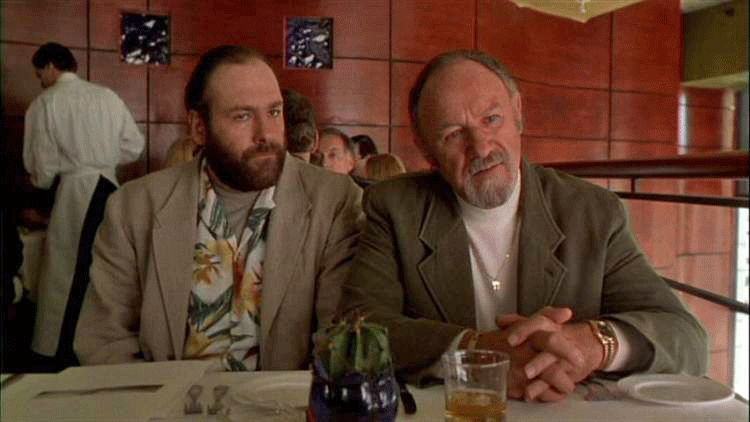
All the way. I must admit I was surprised to see the film had become a comedy. I told [director] Barry Sonnenfeld after I saw it, ‘I don’t write comedy.’ He said, ‘No, but it’s a funny book.’ Barry and [screenwriter] Scott Frank were conscientious about sticking to the plot and using as much of the dialogue as they could. The lines were delivered the way they were written, seriously, the way I’d heard the characters when I was writing their lines. Gene Hackman was delivering his lines one day in rehearsal, and Barry said, ‘Gene, that was really funny,’ and Hackman said, ‘Well, I wasn’t trying to be.’ Barry said, ‘That’s the whole idea.’

I do think my books were getting a little funnier as I loosened up, toward the mid-Seventies. I had become a little freer and easier in the way I was writing – not trying so hard to write – and funny things began to happen to the characters.

Going back to The Big Bounce in ‘68, however, I've been working pretty much with the same characters: ordinary people who seem a bit quirky, non-heroes, spending as much time with the bad guys – who usually aren’t too bright – as I do with the more sympathetic characters. I have an affection for all of them, so I treat them as human beings with much the same desires and hangups we all have. Plot is secondary, not that important to me. Once I know my characters I’m confident a plot will come out of them. I make it up as I go along, not knowing what’s going to happen, never knowing how the book will end.

Get Shorty (Directed by Barry Sonnenfeld)
‘Not knowing what is going to happen’ is part of the comedy, it seems to me. Part of the Elmore Leonard experience. There are always amazing plot twists in your stories.

What’s amazing to me, when I think about it, is that while Hollywood in general prefers plot driven stories – they ask, ‘What’s it about?’ – 33 of my 35 books, all character-driven and talky, have either been optioned or bought outright for film. I write a book not knowing what’s going to happen, so I won’t be bored, so I can entertain myself making it up as I go along, establishing characters in the first act I hope to be able to use later on, for a set-piece or two if not turns in the plot. If a plot twist is amazing, as you suggest, it must be at the same time believable. So I write each scene from a character’s point of view, with the character’s ‘sound’ providing the rhythm of the prose and the believability of what’s taking place in the scene. The reader accepts it because the character is there. It might not be acceptable from my point of view, were I an omniscient author who thinks he knows everything. Their ‘sound’ is much more entertaining than mine, so I try to keep my nose out of it. I don’t want the reader ever to be aware of me writing. And if the prose sounds like it was written, I rewrite it.

Jackie Brown (Directed by Quentin Tarantino)
On ‘Jackie Brown’, did you read Quentin Tarantino’s script?

Yeah. It’s pretty much the book, with a lot of Tarantino, of course, a lot of additional dialogue.

Did you give Tarantino any input?

I questioned a couple of things, asked why scenes we both liked were left out. But I only spoke to him twice on the phone. The first time was a couple of years ago, when he was just beginning and told me he was going to do Rum Punch instead of Killshot. That was all I heard from him for about a year and a half, until just before he started shooting, in early June [‘96], when he called again. He said, ‘I've been afraid to call you for the last year.’ I said, ‘Why? Because you’ve changed the title and you’re starring a black woman in the lead?’ He said, ‘Yeah.’ I said, ‘Do what you want. You’re the filmmaker, you’re going to do what you want anyway.’

I was on the set twice, and both times it looked like he was enjoying himself. I met Sam Jackson and Pam Grier, who looked terrific, and I could see why Quentin wanted her. Bridget Fonda I’d met before, doing publicity for Touch, and I was happy to see her in the picture. I trusted Quentin and felt certain the film would work; though I suppose there will be a few smartass critics waiting to take a shot at him.

So, all of a sudden, you’re ‘hot.’

It doesn’t seem that long ago I had hopes of being the hot kid, selling my first story in ‘51 when I was 25. I got on the cover of Newsweek in April 1985, and was seen as an overnight success after little more than thirty years. Now I’m 72 and still at it, writing a sequel to Get Shorty that puts Chili Palmer in the music business, where, with his mob-connected background, he should feel right at home. In doing the research, learning about the record industry, the success of Get Shorty has opened all the doors. We’ve even had Aerosmith over to the house to drink non-alcoholic beer and play tennis. MGM, Jersey Films, and John Travolta all seem optimistic that it will happen. I am, too, but I have to finish writing the book before we’ll know if is any good. Or even what it’s about.

– ‘On Writing and Movies. Elmore Leonard interviewed by Patrick McGilligan’. Film Comment Magazine.