Friday, 25 February 2022

The Art of War: David O. Russell on Three Kings

Three Kings (Directed by David O. Russell)
Writer/director David O. Russell is best known for Oscar-nominated films such as Silver Linings Playbook, American Hustle and The Fighter. But before these, it was his critically-aclaimed 1999 film Three Kings that arguably launched his career. 

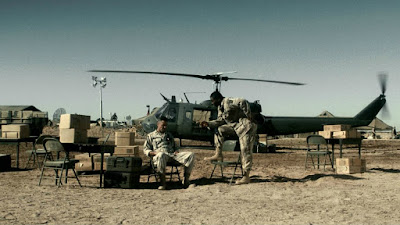
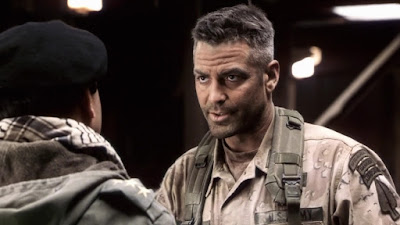
Three Kings is a darkly comic action-adventure set in the aftermath of the Gulf War. The military battle has barely concluded as the film opens, with the discovery of a map hidden on the person an Iraqi POW. For Capt. Archie Gates (George Clooney), a suavely cynical Green Beret, the find promises legendary fortune, since the map seems to indicate desert bunkers where Iraq has stored piles of stolen Kuwaiti bullion. Archie quickly assembles his own three-man liberation squad and departs through the dunes in a Humvee draped in an American flag.

The three enlisted guys are likeable youngsters engaged in risky play; they are also acted quite flawlessly. Sgt. Troy Barlow (Mark Wahlberg) is a devout Army reserve who wishes to return to his wife and infant daughter in Detroit. Chief Elgin (Ice Cube) is a devout Christian who thinks that "the good Lord has provided us with this map." Conrad Vig (Spike Jonze) inquires if Kuwaiti bullion refers to "those small cubes you put in boiling water to make soup"; Conrad makes up for his lack of intelligence with a passion for high explosives. 

Archie, on the other hand, is a fully developed adult and an apt hero for an unusually complicated picture. If his warrior's cynicism is strong, his sense of outraged humanity is as powerful. He savours the surreal craziness that ensues when he and his companions first enter labyrinthine bunkers filled with such lesser riches as televisions, stereos, and mobile phones; the contemporary world is suddenly regarded as a massive underground appliance shop. When Kuwait's stolen gold is discovered, carefully packed in soft-sided luggage, the bars are gleaming and ready to be taken again, but there is a catch, and it is located in Archie's heart. 

And at the core of the film, because writer-director David Russell has blended terrific, hard-edged action with a profoundly felt morality drama. His script takes subtle aim at the United States' foreign policy as he reveals that the US Administration supported a revolt against the Iraqi tyrant and then abandoned the defenceless rebels to their destiny. 

David O. Russell is at ease in the scatological mayhem that unfolds. His early films, the dark comedies, 1994's Spanking the Monkey and 1996's Flirting With Disaster, first brought his piercing comedy style to the festival circuit. 

Three Kings is replete with allusions to previous films: Apocalypse Now, The Man Who Would Be King, also paying homage to Natural Born Killers by including an aspirational television journalist. The film's visuals are frantic, striking. Archie, Troy, Vig, and Chief gallop their Humvee through an overexposed inferno that bursts in gunfire, mine explosions, and rapid dialogue. Apart from the contemporary generation of action filmmakers Quentin Tarantino and John Woo, there is also a good deal of John Huston here. As with Huston's The Asphalt Jungle, The Maltese Falcon, and Beat the Devil, this is a sublime caper picture that openly wishes for the success of its criminal enterprise and finds its crooks far more appealing than the forces of decency they resist. 

Its strongest visuals owe much to the surreal comic work of the novelist Thomas Pynchon. The desert is place of striking contrast, an ancient landscape that the West has devastated without logic and less compassion. The troops of Three Kings have nothing to say about the vague diplomatic world that justified the war; they are much more concerned with what they they can carry home. For Archie and his troops,  the war is an opportunity for what they can get away with and Russell interweaves the antics of his crew with the more serious issue of an American foreign policy gone awry with respect to the oppressed people's freedom that was the war’s justification.

In the following extract from an interview with Creative Screenwriting Russell discusses disagreements over writing credits, moving from independent to studio films, and the dark heart of the movie.

How did you set up ‘Three Kings’ at Warner Bros.? It’s a very brave film for a major studio. Did they come to you?


Yes. It was a very odd and serendipitous process: David’s Adventure in Studio Land. I thought, what would this be like, to work with something from their candy box? They opened up their logbook to me and this one log line jumped out at me, which was a heist set in the Gulf War, a script by John Ridley. A pretty straight action movie. I couldn’t stop thinking about it. In fact, I was researching another script, a turn-of-the-century story, and I didn’t feel I had cracked it, so I started buying books about the Gulf—photojournalist books that had amazing images in them like hundreds of soldiers being stripped in the desert and Bart Simpson dolls on grills of cars. All this incongruous stuff. There was once a scene where they ate animals in the zoo...

So you found the log line—

It took me by surprise and eventually to everybody’s surprise, I said, ‘I think I want to do this.’ And everybody’s eyebrows went up. Including my agent’s. They were all like, ‘What?’ I said it’s going to be crazy textured, with all the politics and everything. To me, the heist is the least interesting part. So I went off, researched, and wrote it for eighteen months. It was a fun scriptwriting process, like no other I’d ever done. I would make columns of things I found fascinating, and then I would build the script that way. So it’s not character-driven, which is obvious from the movie. There was very volatile material which hadn’t been put in the face of Americans about what really happened there. I read papers, talked to veterans and Iraqis. Then I sewed together the quilt of this script. It was liberating, because it was blank as the desert, a palette where I could do a lot of different things, including action, which I hadn’t done before. I wanted to click on lots of information, like click on their day jobs, click on the wife at home, click on how this punk sees violence as opposed to how violence really is. I’ll do it and see how it works in the editing.

John Ridley has been vocal in his displeasure over credit...

He certainly has. I thought we had an amicable agreement. He was all friendly when we made the credit agreement.

You just used his premise of the heist in the Gulf.

That was all I took from his script, and frankly, that’s the most boring thing about the movie. Which in a way was an albatross, because I thought it was going to help me write faster. It was sort of the opposite.

Ridley was part of the process in the beginning?

Yeah, he sold his script. Like every other writer. I don’t understand what his whining is about because it’s the most common experience in Hollywood. You write a script, you sell it and get paid. Goodbye. You’re lucky you’re not rewritten 700 times. If he wants to direct his own scripts, he should control them a little bit. If he thinks it’s such a work of genius, I think he’d let me publish my script. I even offered to publish both scripts in one volume.

That’s a great idea.

He won’t do it. He got paid, he got co-producer credit, he was all amicable. I wanted to publish the screenplay and then he started playing the jilted writer.


Did he see the film and have a problem with it?

Not to my knowledge.

Was there WGA arbitration at all?

No. He decided not to. I was happy to go either way because I knew I had a very strong case. I think what is truly accurate is screenplay by me, and story by him and me. With him getting first position. He said he wanted sole story credit. I said okay and he got co-producer credit.

Is this going to make you wary in the future?

Oh yeah. [laughs]

You used to be an activist, so did you purposely set out to spotlight our foreign policy?

Definitely. That was one of my main motivations. It wasn’t dealing with characters so much as I did in my other movies, it was being driven by the political charge of the material. I couldn’t believe that no other filmmaker had gone after this and I couldn’t believe that Warner Bros. was going to let me do it.

Why did they?

They were hungry to work with independent filmmakers. They’ve done it before.  They were happy to let me do my thing.

In terms of action movies, are you a fan or was it new territory?

I’m not a huge action movie fan, although the other idea that was a big motivator was violence. There hadn’t been a war film since Platoon, so I thought, ‘Great! I’m going to explore this territory in a totally different way.’ So while I’m writing it I find out that Spielberg and Malick are doing these epic war movies! Yet mine was contemporary and nothing like theirs. The whole process of resensitizing violence cinematically captivated me at the time. I felt that bullets had become glib and cartoonish, even in really smart independent movies, so I wanted to render their impact more real. Sometimes I write in friends’ homes, and I have a friend who was a doctor in an emergency room. I was writing and I said to him, ‘What exactly does a bullet do?’ We talked about it and I thought, ‘I’m going to write this, show this, and if it doesn’t work we can cut it later.’

In the script, you also indicate a lot of visual directions.

That took a lot of work to translate that to the camera department.

So when you’re writing, you see exactly how you want to shoot the scene.

Yes. Then you have to make that technically happen. You have to experiment. Definitely with the shootout. When we looked at the first cut of the shootout, I didn’t think it was going to work. I said, ‘Thank God, we covered this normally.’ And the editor says, ‘But you guys didn’t cover it normally.’ I was shitting my pants thinking we were going to reshoot!


There are lots of cool visual touches in the film.

I’m totally a beginner filmmaker, and I’m learning. My motives were political and informational, but also visual. I’d never been so visually motivated in any screenplay I ever wrote. Any flaws in the film are attributed to this, as well as its assets. I was experimenting with being a more visual writer. We studied these photojournalists, like Kenneth Jarecke’s book Just Another War, and it’s amazing—haunting black and white photos of the Gulf War. A brilliant book. We strove for that look in the film: a big, blank empty landscape with a person here and a truck way far away, that kind of thing. It was a little bit film school for me, so I’ll take a lot that I learned and go back to something that’s closer to my ballpark.

I think the dark heart of the movie is the interrogation scene. You get to hear the other side’s version of things. It’s horrifying what happens to Mark Wahlberg, but you can’t hate the interrogator.

One of the things that inspired me was that the war was like a computer picture from an airplane. So who are the people? It’s a dangerous thing because you can dehumanize the enemy. What would it be like to meet an Iraqi who didn’t want to serve in Saddam’s army—which most of them don’t want to – and bring him face to face with an American. That was exciting to me.

Did you interview any Iraqi soldiers?

We did. A lot of the people in the movie were Iraqi and we cast them out of Deerborn, Michigan, where there’s an Iraqi community.... I met a lot of them after I finished the script and asked if this was right, or this. But as a writer, you’d be surprised at how many of one’s instincts are right, strictly from intuition. I don’t know if it was Henry James who said as a writer, you should be able to walk by a house, and if the door opens for a moment and you get a glimpse into the kitchen where people are eating, then when the door closes, you should be able to write a story about that house.


Do you have certain habits to get yourself in the mood?

I have to write down all the things about an idea that excite me and I have to have the whole menu at my disposal. Sometimes I have charts on the wall. Once I outline—and I outline and outline—I have to insist that I write eight pages a day, otherwise I’ll never finish the script, or I’ll go over a couple pages a million times. Then I give it to another friend of mine so I can’t go back. You have to keep marching forward or you’ll never get it out of your head. I write longhand and then I transcribe onto the computer.

How long did it take to write Three Kings?

I had about a 200-page script after six months, but I wasn’t happy with it. I put it down for a few months before it became closer to my own version.

You gave it to the studio and they said go ahead.

At the beginning, they said, ‘Where’s the script? We paid you the advance and we normally expect a first draft in twelve weeks.‘ And I said, ‘That’s why most of your movies suck.’

‘Three Kings’ has done pretty good box-office. Is the studio happy with the outcome?

They’re very happy with it. Of course, everybody gets all pumped up when the tests are good and the advance press is good. Before that, we had more realistic expectations because the movie is provocative. It’s going to make money for them, I think.

What are the film or script influences on your work?

Definitely the films of the ’70s. I’m a big fan of Wes Anderson and Paul Anderson. All those Andersons. I love Alexander Payne. Chinatown. I watch a lot of movies. But I tend to watch movies I like over and over.

– ‘Not a Typical Action Movie: David. O. Russell on Three Kings’, Creative Screenwriting, March, 2016. Full interview here

Saturday, 12 February 2022

On John Cassavetes’ Style

Faces (Directed by John Cassavetes)
“John Cassavetes’ Faces is the sort of film that makes you want to grab people by the neck and drag them into the theater and shout: "Here!" It would be a triumphant shout. Year after year, we get a tide of bilge that passes for "the American way of life" in the movies.

“We know it isn’t like that. We don’t live that way and neither does anyone we know. What Cassavetes has done is astonishing. He has made a film that tenderly, honestly and uncompromisingly examines the way we really live.

“The central characters are middle-aged, middle-class and rather ordinary: a man and his wife. They have everything in the world they desire, except love and a sense of personal accomplishment. They’ve become consumers in the most cruel sense of that word: Their only identity is as economic beings who earn and spend money to sustain a meaningless existence. They don’t do anything, or make anything, or create anything. They use.

“This is not only a crisis but a trap, because society has left them stranded without any means of breaking out. During a long night when their marriage reaches the breaking point, they discover only two ways to kick loose: alcohol and adultery. One of the problems with this class of society is that it provides so few ways to boil over.”

– Roger Ebert.

“Cassavetes wiped away the old vocabulary of doing films. A lot of this came from his New York actors, the street-life sound, and from the ability the new lightweight equipment gave the filmmaker. When I saw Shadows, with the camera right in that house giving such a direct communication with the human experience, with conflict and love and all of this, it was as if there were no camera there at all, as if you were living with these people. Once we saw that, we all realized that you can’t sit around and talk about making a film, you gotta just go do it. He exemplifies independence: Don’t be taken in by them. Do what you feel, what you feel in your heart. Don’t be cut down. He was like an uncle in the way he talked to you about this.”

– Martin Scorsese.

John Cassavetes took his first serious move towards being an actor in 1949, when he enrolled at the American Academy of Dramatic Arts. Following graduation, he performed in provincial theatre and enlisted in the Army Reserves, where he was a member of the performing arts organisation. Cassavetes began his career in the early 1950s, landing tiny television parts and appearing in his first credited film, The Night Holds Terror (Andrew L. Stone, 1955). He met Gena Rowlands, who was also a student at the institution, during this period. On 19 March 1954, the two married, and though their partnership was not always easy – professionally or emotionally – it was one of the great cinematic partnerships. From 1954 until 1956, Cassavetes appeared in dozens of television shows, including a notable role in Don Siegel's film Crime in the Streets. Cassavetes was also preparing for his directorial debut prior to securing the main part in the television series Johnny Staccato (1959–60). 

As Cassavetes described it, "Shadows [1959] started as a dream on 13 January 1957 in a New York loft." That loft was home to The Cassavetes-Lane Workshop, a collaborative effort between Cassavetes, theatre director Burt Lane, and a group of young actors who workshopped scenes based on initial character sketches and situations. The objective was to turn these improvisations into a full length film. Cassavetes issued a plea to listeners on Jean Shepherd's Night People radio programme to help finance the production of a film, through donations. While race was a factor in the creation of Shadows, Cassavetes rejected any overt message. While the film's premise was oprn to debate, the creative nature of the endeavour was unmistakable: "it was an experiment throughout, and our primary purpose was to learn," Cassavetes said. 

The film's grainy starkness, improvised dialogue, jerky editing, occasionally incongruous mise-en-scene, and dramatic changes in focus and lighting all contributed to Shadows' energy. The unaffected performances of Ben Carruthers, Lelia Goldoni, and Hugh Hurd – who play a trio of siblings threatened by racial ignorance and the parameters of racial identity – are aided by Cassavetes' penchant for long takes; when a scene went wrong, he would restart it from the beginning to give the actors time to settle in and bring the characters to their fullest realisation. Shadows is unmistakably a film of its day, replete with the urban bustle, banter, and brooding posturing associated with the "Beat Generation." Individuals lecture about art and ruminate about life in this bohemian atmosphere. Sexual and relationship conversations range from casual and unimportant to intense and therapeutic. The film's wider storey is concerned with the instability of family relations, a theme that runs through most of Cassavetes' work. 

Following three preview screenings of Shadows, a 15-day round of reshoots resulted in around an hour of new, more polished content. Some, particularly writer and director Jonas Mekas, who saw and loved the rougher early version, saw the final release as a commercial surrender. Contrary to its finishing title, which implies that the film is an improvisation, the majority of what made it into the final cut was written. While several street shots were shot on the fly, disguising the camera and filming from a distance to avoid being stopped by police due to the crew's lack of permissions, numerous interiors were constructed sets at the Variety Arts studio. The much-lauded aesthetic of the picture was born of necessity and inexperience. “The things for which we were applauded were the ones for which we attempted to cure,” Cassavetes later said. Elsewhere, he said, "We had no idea how to make a film. I never saw myself as a director.” Nonetheless, he was now a director in demand. Cassavetes was quickly and rather unexpectedly awarded a contract with Paramount, which included the option to direct a picture of his choosing with a modest budget, studio staff, and famous cast. Although Too Late Blues (1961) was an attractive project on paper, the six-week production, rigid filmmaking philosophy, and lack of opportunity for spontaneous creativity resulted in a conventional, predictable work.

Despite its production conditions, Too Late Blues carries over a recurring Cassavetes subject from Shadows - that of creative integrity in the face of opposing objectives. This drama about trendy musicians and their professional and personal conflicts is inhabited by rowdy men bound by volatile relationships, as they are so often in Cassavetes' work, who find themselves at odds over individual objectives. Additionally, the extra subplot of a troubled relationship between John "Ghost" Wakefield (Bobby Darin) and Jess Polanski (Stella Stevens) provides surprising sexual candour, but is otherwise clichéd and cold.

Too Late Blues employs a more controlled and balanced approach than Shadows, giving the picture a more consistent, although less energising, visual identity. Even the debates get more sophisticated within the boundaries of the clearly scripted. In contrast to Shadows' narrative variety, with its sometimes shaky but always dynamic structure, Too Late Blues' tempo becomes mired down in forced seriousness. The film makes a determined effort to be trendy, with language that Tom Charity describes as a "self-conscious mixture of jazz jive and hardboiled poetics." However, Marshall Fine says that Too Late Blues seemed "naive and square" even in 1961. In the end, it's a solid sophomore effort, though one that was artistically compromised. 

Cassavetes' follow-up production, A Child is Waiting (1963), was produced by Stanley Kramer, the renowned "problem cinema" producer. With Burt Lancaster and Judy Garland appearing as instructors at a school for the mentally disabled, this is the most apparent example of polished, Hollywood shine in Cassavetes' work. The film's visuals are accompanied by a mournful soundtrack, and though it successfully tugs at the melodramatic heartstrings, its tone is usually subdued. It is also possible that this is Cassavetes' most sentimental work. A less personal endeavour, A Child is Waiting touches on recurring Cassavetes themes, including the search for meaning and purpose in life, the notion of normality in an aberrant world, and the difficult balance between professional obligation and personal emotion. Nonetheless, the picture marked a low point in Cassavetes' unto then, brief career as a filmmaker. Conflicts with the frail Garland, disagreements with Lancaster, and interference from a possessive Abby Mann, the original novel's author, were worsened by subsequent confrontations with Kramer over the final edit. 

Cassavetes' much more distinctive follow-up was a more striking effort – a feature-length home movie funded entirely out of his own earnings. Faces (1968) is a fascinating, uncomfortably personal portrayal of middle-age melancholy and the resulting breakdown of connection. Faces was "a triumph of begging, borrowing, and on occasion, stealing whatever was required to create it." The six-month production (which took place mostly at night to allow everyone to work their day jobs) resulted in 150 hours of video, which was culled from a screenplay that weighed in at roughly 320 pages. Faces came to an end after three years of post-production labour with a rough cut of 230 minutes. Despite its logistical difficulties, Faces benefited from being an entirely autonomous production from conception to finish, which meant no aesthetic sacrifices. 

Faces is Cassavetes at his most emotional. The penetrating titular close-ups of the people at their most energetic establish a deep familiarity via jagged cutting and extremely erratic shot choices. The film's coarseness depicts the manner in which everyone involved behaves. Men may be vulgar, with intermittent and caustic cruelty, while women may be rowdy, with their own social/sexual norms of behaviour. Each group is ready to criticise the other, rather than admitting their own vulnerabilities and frailties. The film is a whirlwind of audiovisual components, making it impossible to discern what is scripted and what are ad hoc digressions. The air is filled with screaming, laughter, enthusiastic gesticulations, and constant movement. The speech loops endlessly in mostly meaningless interactions, and there is no traditional plotline to speak of. Faces, on the other hand, is a character-driven depiction of lives ruled by an ever-changing variety of emotions. Physical and spoken interactions are verbose, and responses are unpredictable, reflecting and affecting the film's formal elements. When merely filming in the trenches of fierce conflict, the turbulence is captured in painful detail and for an extended period of time. The viewer, like the protagonists, is pushed through emotional trauma.

Cassavetes began Faces with no expectations, yet the picture became a box office success, winning multiple accolades and critical acclaim and grossing more than US$8 million. It "offers a very profound dissection of male and female role-playing – and the explosive intensity of honest behaviour when the roles are shed," Fine writes. Cassavetes believed the filmmaking process to be the happiest period of his life.

In the following extract from his book ‘Cassavetes On Cassavetes’ the film critic and writer Raymond Carney discusses Faces interspersed with extracts from John Cassavetes discussing his attitude toward the film.


Raymond Carney: American viewers were divided in their opinion. Though many appreciated Faces, at least as many had major problems with it. One frequently voiced objection was that Cassavetes failed to explain his characters’ motives and the causes of their behavior. As early as Too Late Blues he had argued that he didn’t want to explain too much because the work the viewer had to do was an important part of the experience. Faces went even further in this direction – confounding viewers’ expectations, placing them in a problem-solving stance and forcing them to stay in the flow of experience.

John Cassavetes: The first part of the script was structured very carefully to set up a whole new pattern of thinking so that the audience could not get ahead of the film. Most people think, ‘Oh yes, this is what’s going to happen in the next moment.’ What happens with Faces, though, is that the first half of the film really bugs people because it doesn’t fit an easy pattern of behavior. Well, I don’t know anyone who has an easy pattern of behavior. I know people who are just sensational one minute and absolute bastards the next. Terribly funny one minute and morose the next. And these moods come from specific things that I can’t put my finger on because I don’t know their whole life. And we can’t put their whole life on the screen. So I’ve got to depend on the actor to identify with his role enough that he can express those things. And to get it on the screen is something miraculous.

It’s antagonism. With Faces you’re getting so many vibrations from people and you’re seeing people behave so honestly, when they stop you get irritated. You identify with a character and then he does something you don’t want him to do, it becomes personal. You can’t stand for it not to have the answers every moment. You don’t want to waste your time going through their self-exploration. You want them to get right down to it and give you the answers. Other movies make me bored. I want them to go faster, you know. Hurry up. I want it to go faster because I’m not interested in it. I like things that evolve.


Although at the end of the following statement Cassavetes confuses the 183-minute version of his film with the final edit, his point is still valid.

JC: People prefer that you condense; they find it quite natural for life to be condensed in films. And then you discover that people prefer that because they’ve already caught on to what you wanted to say and are ahead of you. So that there’s a sort of competition between them andyou, and you try to shake them up rather than please them: you show them that you know what they’re going to say so as to be more honest than they can imagine. For example, when Faces opens, the couple are lying in bed, laughing. The audience wants to join them but they’re not included yet. The characters dictate the terms to the audience.

Other viewers were frustrated by Cassavetes’ unwillingness to explain his characters’ problems in psychological terms – holding the viewer on the outside of opaque, impenetrable surfaces. Cassavetes felt that tracing behavior back to psychological causes was to simplify it.

JC: I’m a very literal man. I never look for anything underneath. I don’t know why people always want to understand, work out hidden meaning and motivations. Surely the only reason for trying to work out someone’s motivation is if you’re scared of them. Otherwise you just feel for people, don’t you? You love them or you hate them. This is a film about people’s surfaces, isn’t it?


Another issue for many viewers was what they felt to be Cassavetes’ toughness or cynicism, at least in part because of his avoidance of the stock-in-trade of Hollywood filmmaking: swoony, romantic relationships between characters and between the viewer and a character. Cassavetes readily acknowledged this aspect of his style.

JC: The movie hates ‘sensitivity’. Sensitivity is hypocrisy in the self-pitying way. True sensitivity should be truly honest. That’s what we strove for: brutal, unsentimental honesty.

A related issue was that Cassavetes’ characters almost never verbally expressed love or affection for one another. (Later in life, Cassavetes said he actually went through the scripts of both ‘A Woman Under the Influence’ and ‘Gloria’ and deleted lines of dialogue where a character used the word ‘love’.)

JC: I really resent being liked openly. I don’t find any challenge in being liked. It’s a form of agreement and very often agreement doesn’t really get anywhere. I always feel that when someone says ‘I love you’, they really mean ‘I hate you’. It seems to me something’s wrong when someone has to express that or wants to hear it. It expresses some fear or doubt.

In a parallel vein, the highest compliment Cassavetes could pay his characters was to say that they weren’t ‘sentimental’ – meaning that they didn’t feel sorry for themselves, or stop and bemoan their situation, but gamely ‘went on’, doing the best they could with the hand they were dealt. (He would later argue that that is what made the central character in ‘The Killing of a Chinese Bookie‘ admirable.)


JC: In Faces there’s this scene with Florence, the middle-aged lady, and the hippie. I get a lump in my throat every time I see it. Gets me every time. Here’s this beat-up broad out to seduce a young guy she picked up at a discotheque and she tries everything and doesn’t care how ridiculous or pathetic she looks. She wants this guy and she wants to get him in the sack. I think she might have succeeded if that younger chick hadn’t been there too, all cool and available. The point is the middle-aged lady tried. She fought; she struggled; she wouldn’t give up. Isn’t it better to fight to see your fantasies realized – fight and lose, rather than suffer and dream away in silence? What I love about all of the characters in Faces is that they don’t quit. They will make jackasses of themselves but they try to keep going. It doesn’t matter if you’re wrong if you try.

The excitement of watching Faces is to see a different point of view, not a romanticized point of view like a Hollywood movie would make it or a self-justifying point of view as some other filmmakers might make it, but to see totally unedited behavior, to look at a life experience without any point of view outside of the people themselves. I think that is some- thing different from other movies. It’s fascinating to me. And painful too. I sit there not as the maker of the film. I’m looking at the film as an outsider. Not as a film. I’m relating to certain characters in the thing that are part of me. Some of them behave as I behave. And some don’t. But I like or dislike them not on the basis of my writing, but on the basis of their acting, on the basis of what they mean to me. I don’t think thedirector creates anything. I liken it to a reporter’s function – if it happens, something’s going to come out, and if it’s dull, nothing in the world is going to save it.


Even at the peak of ‘Faces’ success, Cassavetes understood that popularity was a trap.

JC: My films are about personal things – marriages breaking up, love transformed by mutual treachery, the difficulty that two people have in communicating even though they live together. These are the problems which I have tackled and which concern me and concern others. Some- times people find this painful to accept or they think that my ideas are wrong or simply they’re not interested in the difficulties which exist in communicating with others. But I am very interested in this. With my actors I try to explore it and try and relate it to their daily lives. I can’t ask people who are comfortable with their lives, with no problems, to be spectacularly interested in my work. It’s not made to please people. Many press agents told me, ‘For God’s sake, don’t sell the movie on middle age.’ But I’m sure there are some middle-aged people around. I always feel left out of most other movies. They have nothing to do with me.

I don’t care if people like our films or not. As long as I can make these films and say what I want and work with people I love and who are not afraid to express themselves, whether it’s popular or not. If we want to give Faces away to universities, we will do that. If we want to bury the film and never let anyone see it, we can do that. In other words, it’s ours. So that if it plays in a festival, fine. If it doesn’t play in a festival, fine. If people love it, fine. If they don’t, OK too.

– Extract from Cassavetes on Cassavetes, by Raymond Carney.

Friday, 4 February 2022

Alfred Hitchcock Talks to Francois Truffaut

Psycho (Directed by Alfred Hitchcock)
Once a week for ten years, beginning in 1955, Hitchcock introduced his popular television show with a formal “good evening, ladies and gentlemen” spoken in an exaggerated British accent, sounding something like a movie version of an English butler. He was sarcastic and ironic; he mocked his sponsors and himself. He had, in short, a good time at everyone’s expense, his own included. The publicity and public exposure his appearances provided was invaluable. Despite the fact that Hitchcock coveted a quiet, creative life, he wanted everyone to know who was responsible for the films he created, as evidenced by the fact that he quite literally wrote himself into his films by means of brief, silent cameos in almost all of them. These, and the television series, guaranteed an almost personal engagement with his audience.

Hitchcock wanted another kind of engagement, however. As Robert Kapsis has pointed out, he wanted critical, even scholarly, recognition of his work. This began in the late fifties in France, a country that always took filmmaking seriously. The first book-length study of his work was written in 1957 by two French critics who would soon become important directors in their own right: Eric Rohmer and Claude Chabrol. In 1962, one of the most famous of the “new wave” of French directors working in the late fifties and throughout the sixties, Francois Truffaut (who made, among many other films, The Four Hundred Blows, Shoot the Piano Player, and Fahrenheit 451), began a career-long interview with Hitchcock. The result was many days of conversation, conducted with the assistance of a translator, that finally appeared in a book called, simply enough, Hitchcock/Truffaut. In it, Hitchcock continued what he did in most other interviews. He talked about the structure of his films, his love of the form of film itself, and all the things that could be accomplished with it. He talked about his profound awareness of the audience and how they could be manipulated to respond the way he wanted them to. He never talked about the narrative depth of his work, about its emotional and psychological complexities (the closest he gets is the reference in the interview to his own desire for orderliness in his life). Otherwise, he always left interpretation to others.

In the following extract Francois Truffaut talks to Alfred Hitchcock about “Pure Cinema,” Playing His Audience Like an Organ, and Psycho.


F.T Before talking about Psycho I would like to ask whether you have any theory in respect to the opening scene of your pictures. Some of them start out with an act of violence; others simply indicate the locale.

A.H. It all depends on what the purpose is. The opening of The Birds is an attempt to suggest the normal, complacent, everyday life in San Francisco. Sometimes I simply use a title to indicate that we’re in Phoenix or in San Francisco. It’s too easy, I know, but it’s economical. I’m torn between the need for economy and the wish to present a locale, even when it’s a familiar one, with more subtlety. After all, it’s no problem at all to present Paris with the Eiffel Tower in the back- ground, or London with Big Ben on the horizon.

F.T. In pictures that don’t open up with violence, you almost invariably apply the same rule of exposition: From the farthest to the nearest. You show the city, then a building in the city, a room in that building. That’s the way Psycho begins.

A.H. In the opening of Psycho I wanted to say that we were in Phoenix, and we even spelled out the day and the time, but I only did that to lead up to a very important fact: that it was two-forty-three in the afternoon and this is the only time the poor girl has to go to bed with her lover. It suggests that she’s spent her whole lunch hour with him.

F.T. It’s a nice touch because it establishes at once that this is an illicit affair.

A.H. It also allows the viewer to become a Peeping Tom.

F.T. Jean Douchet, a French film critic, made a witty comment on that scene. He wrote that since John Gavin is stripped to his waist, but Janet Leigh wears a brassiere, the scene is only satisfying to one half of the audience.

A.H. In truth, Janet Leigh should not have been wearing a brassiere. I can see nothing immoral about that scene, and I get no special kick out of it. But the scene would have been more interesting if the girl’s bare breasts had been rubbing against the man’s chest.


F.T. I noticed that throughout the whole picture you tried to throw out red herrings to the viewers, and it occurred to me that the reason for that erotic opening was to mislead them again. The sex angle was raised so that later on the audience would think that Anthony Perkins is merely a voyeur. If I’m not mistaken, out of your fifty works, this is the only film showing a woman in a brassiere.

A.H. Well, one of the reasons for which I wanted to do the scene in that way was that the audiences are changing. It seems to me that the straightforward kissing scene would be looked down at by the younger viewers; they’d feel it was silly. I know that they themselves behave as John Gavin and Janet Leigh did. I think that nowadays you have to show them the way they themselves behave most of the time. Besides, I also wanted to give a visual impression of despair and solitude in that scene.

F.T. Yes, it occurred to me that Psycho was oriented toward a new generation of filmgoers. There were many things in that picture that you’d never done in your earlier films.

A.H. Absolutely. In fact, that’s also true in a technical sense for The Birds.

F.T. I’ve read the novel from which Psycho was taken, and one of the things that bothered me is that it cheats. For instance, there are passages like this: “Norman sat down beside his mother and they began a conversation.” Now, since she doesn’t exist, that’s obviously misleading, whereas the film narration is rigorously worked out to eliminate these discrepancies. What was it that attracted you to the novel?


A.H. I think that the thing that appealed to me and made me decide to do the picture was the suddenness of the murder in the shower, coming, as it were, out of the blue. That was about all.

F.T. The killing is pretty much like a rape. I believe the novel was based on a newspaper story.

A.H. It was the story of a man who kept his mother’s body in his house, somewhere in Wisconsin.

F.T. In Psycho there’s a whole arsenal of terror, which you generally avoid: the ghostly house . . .

A.H. The mysterious atmosphere is, to some extent, quite accidental. For instance, the actual locale of the events is in northern California, where that type of house is very com- mon. They’re either called “California Gothic,” or, when they’re particularly awful, they’re called “California ginger-bread.” I did not set out to reconstruct an old-fashioned Universal horror-picture atmosphere. I simply wanted to be accurate, and there is no question but that both the house and the motel are authentic reproductions of the real thing. I chose that house and motel because I realized that if I had taken an ordinary low bungalow the effect wouldn’t have been the same. I felt that type of architecture would help the atmosphere of the yarn.

F.T. I must say that the architectural contrast between the vertical house and the horizontal motel is quite pleasing to the eye.

A.H. Definitely, that’s our composition: a vertical block and a horizontal block.


F.T. In that whole picture there isn’t a single character with whom a viewer might identify.

A.H. It wasn’t necessary. Even so, the audience was probably sorry for the poor girl at the time of her death. In fact, the first part of the story was a red herring. That was deliberate, you see, to detract the viewer’s attention in order to heighten the murder. We purposely made that beginning on the long side, with the bit about the theft and her escape, in order to get the audience absorbed with the question of whether she would or would not be caught. Even that business about the forty thousand dollars was milked to the very end so that the public might wonder what’s going to happen to the money.

You know that the public always likes to be one jump ahead of the story; they like to feel they know what’s coming next. So you deliberately play upon this fact to control their thoughts. The more we go into the details of the girl’s journey, the more the audience becomes absorbed in her flight. That’s why so much is made of the motorcycle cop and the change of cars. When Anthony Perkins tells the girl of his life in the motel, and they exchange views, you still play upon the girl’s problem. It seems as if she’s decided to go back to Phoenix and give the money back, and it’s possible that the public anticipates by thinking, “Ah, this young man is influencing her to change her mind.” You turn the viewer in one direction and then in another; you keep him as far as possible from what’s actually going to happen.

In the average production, Janet Leigh would have been given the other role. She would have played the sister who’s investigating. It’s rather unusual to kill the star in the first third of the film. I purposely killed the star so as to make the killing even more unexpected. As a matter of fact, that’s
why I insisted that the audiences be kept out of the theaters once the picture had started, because the late-comers would have been waiting to see Janet Leigh after she has disappeared from the screen action.

Psycho has a very interesting construction and that game with the audience was fascinating. I was directing the viewers. You might say I was playing them, like an organ.


F.T. I admired that picture enormously, but I felt a letdown during the two scenes with the sheriff.

A.H. The sheriff ’s intervention comes under the heading of what we have discussed many times before: “Why don’t they go to the police?” I’ve always replied, “They don’t go to the police because it’s dull.” Here is a perfect example of what happens when they go to the police.

F.T. Still, the action picks up again almost immediately after that. One intriguing aspect is the way the picture makes the viewer constantly switch loyalties. At the beginning he hopes that Janet Leigh won’t be caught. The murder is very shocking, but as soon as Perkins wipes away the traces of the killing, we begin to side with him, to hope that he won’t be found out. Later on, when we learn from the sheriff that Perkins’ mother has been dead for eight years, we again change sides and are against Perkins, but this time, it’s sheer curiosity. The viewer’ emotions are not exactly wholesome...

F.T. Would you say that Psycho is an experimental film?

A.H. Possibly. My main satisfaction is that the film had an effect on the audiences, and I consider that very important. I don’t care about the subject matter; I don’t care about the acting; but I do care about the pieces of film and the photography and the sound track and all of the technical ingredients that made the audience scream. I feel it’s tremendously satisfying for us to be able to use the cinematic art to achieve some- thing of a mass emotion. And with Psycho we most definitely achieved this. It wasn’t a message that stirred the audiences, nor was it a great performance or their enjoyment of the novel. They were aroused by pure film.


F.T. Yes, that’s true.

A.H. That’s why I take pride in the fact that Psycho, more than any of my other pictures, is a film that belongs to film-makers, to you and me. I can’t get a real appreciation of the picture in the terms we’re using now. People will say, “It was a terrible film to make. The subject was horrible, the people were small, there were no characters in it.” I know all of this, but I also know that the construction of the story and the way in which it was told caused audiences all over the world to react and become emotional.

F.T. Yes, emotional and even physical.

A.H. Emotional. I don’t care whether it looked like a small or a large picture. I didn’t start off to make an important movie. I thought I could have fun with this subject and this situation. The picture cost eight hundred thousand dollars. It was an experiment in this sense: Could I make a feature film under the same conditions as a television show? I used a complete television unit to shoot it very quickly. The only place where I digressed was when I slowed down the murder scene, the cleaning-up scene, and the other scenes that indicated anything that required time. All of the rest was handled in the same way that they do it in television.

F.T. I know that you produced Psycho yourself. How did you make out with it?

A.H. Psycho cost us no more than eight hundred thousand dollars to make. It has grossed some fifteen million dollars to date.


F.T. That’s fantastic! Would you say this was your greatest hit to date?

A.H. Yes. And that’s what I’d like you to do—a picture that would gross millions of dollars throughout the world! It’s an area of film-making in which it’s more important for you to be pleased with the technique than with the content. It’s the kind of picture in which the camera takes over. Of course, since critics are more concerned with the scenario, it won’t necessarily get you the best notices, but you have to design your film just as Shakespeare did his plays—for an audience.

F.T. That reminds me that Psycho is particularly universal because it’s a half-silent movie; there are at least two reels with no dialogue at all. And that also simplified all the problems of subtitling and dubbing.

A.H. Do you know that in Thailand they use no subtitles or dubbing? They shut off the sound and a man stands somewhere near the screen and interprets all the roles, using different voices.

– Good Evening. Alfred Hitchcock Talks to Francois Truffaut about “Pure Cinema,” Playing His Audience Like an Organ, and Psycho.